Coagulation Specimen Transport in Houston: Time Limits
September 27, 2026 · By LabPath Logistics Editorial Team, Medical Logistics Desk
Quick Answer
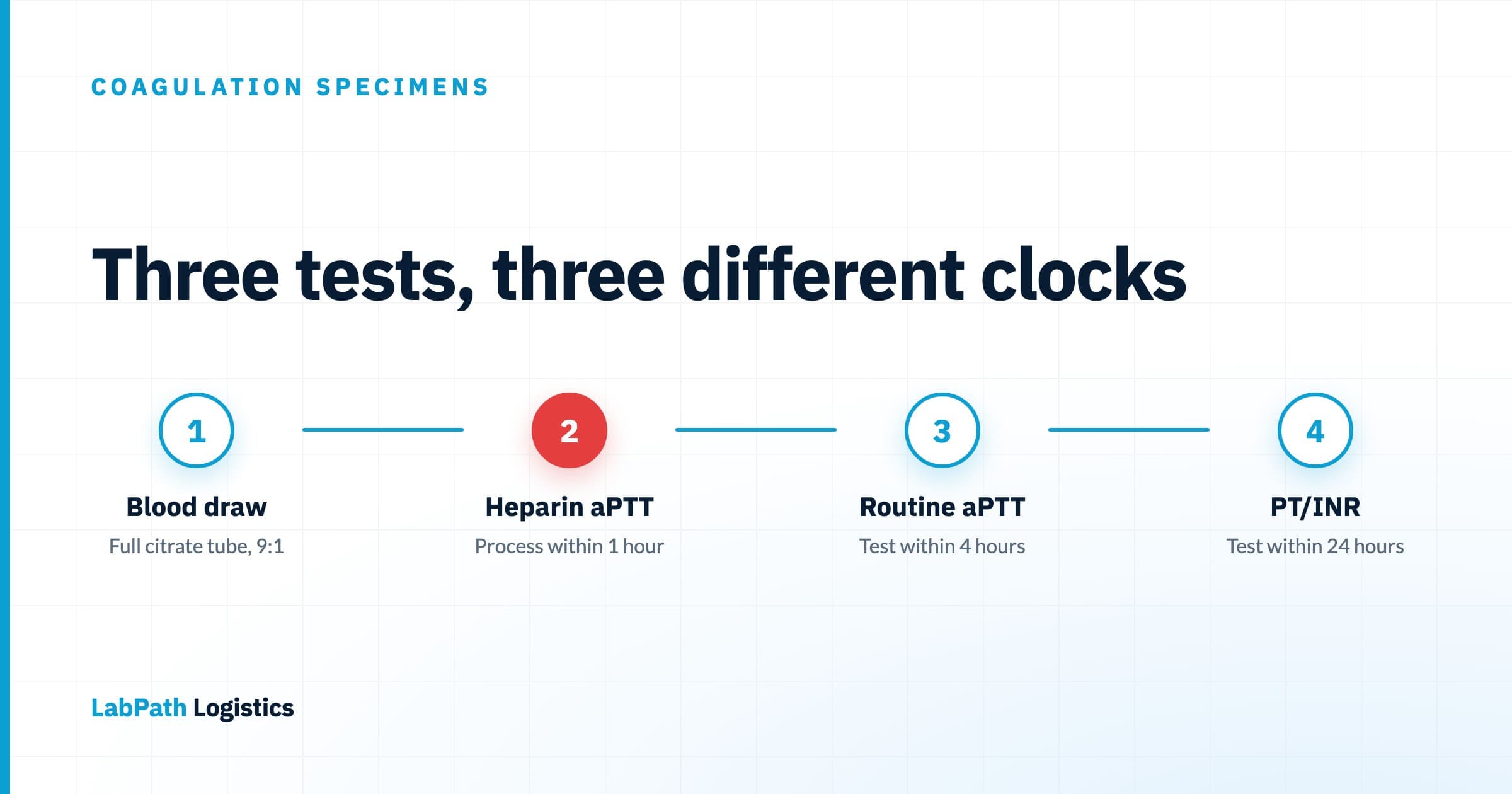
Coagulation specimens in light-blue sodium citrate tubes must be fully filled, kept at room temperature (18–24 °C), and never sent on ice. Under the widely cited CLSI H21-A5 guideline, uncentrifuged PT/INR specimens are stable for up to 24 hours, routine aPTT specimens for 4 hours, and aPTT specimens drawn to monitor unfractionated heparin must be processed within 1 hour. Specimens that cannot reach the lab in time need to be spun and the plasma frozen at the collection site.
Coagulation specimen transport is where a routine courier stop quietly turns into a redraw. A light-blue top drawn for a PT/INR can ride a scheduled route all afternoon. An aPTT drawn from the same patient, in the same bag, may be past its limit before the courier reaches the lab. Treat every blue top the same and some of them will fail.
This guide is for Houston clinic managers, outreach lab teams, anticoagulation clinics, and home health agencies that send citrate tubes to a hospital or reference lab. It covers the time and temperature limits that matter in transit, the handling mistakes that cause rejections, and how to match pickup timing to the test that was ordered. It is logistics guidance only; the performing laboratory's instructions always govern.
Why Coagulation Tubes Run on Different Clocks
Clotting factors degrade at different rates once blood leaves the body. The fifth edition of CLSI H21, the laboratory standard for collecting, transporting, and processing coagulation specimens, set the limits most U.S. test directories still quote. As summarized by hemostasis educator George Fritsma, PT is stable for 24 hours at room temperature, while aPTT is stable for only 4 hours. Specimens drawn to monitor unfractionated heparin must be separated and tested within 1 hour.
- PT/INR: up to 24 hours uncentrifuged at room temperature, the most forgiving window.
- Routine aPTT (no heparin): up to 4 hours at room temperature in an unopened tube.
- aPTT or anti-Xa for unfractionated heparin monitoring: centrifuge within 1 hour of collection.
- Factor assays, lupus anticoagulant, and other specialty tests: usually require spun, platelet-poor plasma frozen on site.
4 hours
Room-temperature limit for a routine aPTT specimen under CLSI H21-A5, compared with 24 hours for PT/INR (as summarized by the Fritsma Factor).
CLSI published a sixth edition of H21 in April 2024 that revised stability recommendations for fresh and frozen plasma. Labs adopt those revisions on their own validation schedules, which is why two Houston labs can publish different limits for the same test. Build your courier plan on the performing lab's current test directory, not on a number from memory.
Room Temperature Means Room Temperature
The instinct to put blood on ice is wrong for coagulation work. As the diagnostics supplier Aniara summarizes the current H21 guidance, whole blood for coagulation testing should travel at room temperature, because transport on ice can cold-activate factor VII and cause loss of von Willebrand factor, factor VIII, and platelet integrity. Heat is a problem too; the Fritsma summary notes that storage above 24 °C hastens factor VIII deterioration.
In Houston, that leaves a narrow band. A bag left on a dashboard in a September parking lot is well past it, and a cooler packed with frozen gel packs next to chemistry tubes is too cold. Citrate tubes need their own ambient compartment, insulated from both extremes.
Keep coag tubes out of the lockbox cooler
Outdoor lockboxes are usually stocked with cold packs for chemistry specimens. That protects serum but can chill a citrate tube placed against the pack. If your clinic uses a lockbox, ask the performing lab whether coagulation specimens may go in it at all. Our guide to [specimen lockbox heat and pickup rules](/blog/specimen-lockbox-houston) covers the rest of the setup.
Handling Errors That Cause Rejections
Most coagulation rejections start before the courier arrives. Labcorp's coagulation specimen guidance requires evacuated tubes to be filled to completion so the 9:1 blood-to-citrate ratio holds, and calls for a discard tube when a winged (butterfly) collection set is used. Hospital hemostasis labs, citing CLSI H21, commonly reject tubes filled below 90%.
- Underfilled tubes. Extra citrate relative to blood falsely prolongs clotting times.
- No discard tube with a butterfly. The air in the tubing short-fills the citrate tube.
- Wrong order of draw. Additive carryover from other tubes can interfere with results.
- Refrigerated or iced transport. Cold activation changes factor levels.
- Missed time windows. An aPTT that arrives at hour five is a redraw.
- Specialty tests sent as whole blood. Many require frozen plasma, shipped frozen.
The stakes are real. Research led by Mario Plebani found that the preanalytical phase accounts for 46% to 68.2% of errors in the total testing process, as summarized in MLO. Transport time and temperature are part of that phase. For a wider view of rejection causes, see our post on specimen rejection and courier handling.
A Houston Scenario
Picture a cardiology practice in Pearland that runs an anticoagulation clinic on Tuesday mornings. Most draws are PT/INR, with a handful of aPTTs for patients being evaluated before procedures. The practice's regular courier stop is at 1 p.m., and the hospital lab in the Texas Medical Center is roughly 30 to 45 minutes away depending on traffic on Highway 288.
The PT/INR tubes drawn at 8 a.m. have plenty of margin on the 1 p.m. run. The aPTT drawn at 8:15 does not: by the time it reaches the lab around 1:45, it has been out for five and a half hours. The fix is not a faster driver. It is a second, earlier stop on clinic mornings, or on-site centrifugation and freezing for aPTTs the lab allows to be sent as frozen plasma. If a heparin-monitoring aPTT is ever drawn at the practice, it needs a direct STAT run or on-site processing, not a route stop.
Coagulation Transport Checklist for Houston Facilities
- Pull each coagulation test's stability limit from the performing lab's current directory.
- Tag every citrate tube by test so the courier knows which clock applies.
- Schedule pickups around the shortest window in the bag, not the most common test.
- Pack citrate tubes in an ambient compartment, never touching cold packs.
- Record draw time on the requisition so the lab can confirm it is in window.
- Centrifuge and freeze plasma on site when the lab requires it or transit will run long.
- Keep frozen plasma frozen in transit, with dry ice or a validated frozen shipper.
- Review coagulation rejections monthly and trace each one to collection or transport.
Timing pickups around draw volume is covered in our guide to sizing specimen pickup schedules, and packaging by temperature range is covered in specimen transport temperature for Houston labs.
Key Takeaway
Coagulation specimens fail in transit for predictable reasons: short fills, cold packs, and pickups timed for PT/INR when the bag also holds an aPTT. Under CLSI H21-A5, the windows are 24 hours for PT, 4 hours for routine aPTT, and 1 hour to process heparin-monitoring specimens. Plan pickups around the shortest clock in the bag and keep citrate tubes at room temperature the whole way.
Frequently Asked Questions
How long is a PT/INR specimen good for?
Under CLSI H21-A5, an uncentrifuged PT/INR specimen in a properly filled citrate tube is stable for up to 24 hours at room temperature. Always confirm the limit in your performing lab's test directory, since labs validate their own stability windows.
How long can an aPTT sit before testing?
Routine aPTT specimens are commonly limited to 4 hours at room temperature in an unopened tube. Specimens drawn to monitor unfractionated heparin must be centrifuged within 1 hour. If transport will take longer, the plasma usually has to be separated and frozen on site.
Should coagulation specimens be refrigerated or put on ice?
No. Whole blood for coagulation testing should travel at room temperature, roughly 18 to 24 °C. Cold can activate factor VII and reduce von Willebrand factor and factor VIII, and heat speeds factor VIII loss.
Why do labs reject underfilled blue-top tubes?
Light-blue tubes hold a fixed amount of sodium citrate for a 9:1 blood-to-anticoagulant ratio. An underfilled tube has too much citrate for the blood volume, which falsely prolongs clotting times. Many labs reject tubes filled below 90%.