Specimen Mail-Back vs Courier Pickup in Houston
November 2, 2026 · By LabPath Logistics Editorial Team, Medical Logistics Desk
Quick Answer
Mail-back works for specimens with a long stability window that your lab has approved for mail, packed to the right USPS and DOT rules. Courier pickup fits anything time-critical, temperature-controlled, or needing a custody trail. Sort each specimen type through four gates: rules, window, temperature, and evidence.
A Houston clinic group sends most of its specimens by courier, and a few kinds by mail-back kit because the kit costs less and nobody has to be on site. Nobody remembers deciding which went where. The split just grew, and now a quarterly invoice and a recollection from the front desk are the only record of why a given specimen type travels the way it does.
This guide gives you one test, the Four-Gate Route Test, for choosing between specimen mail-back and courier pickup in Houston, one specimen type at a time. It covers logistics and operations only. Your reference lab and medical director decide what is clinically acceptable for each specimen.
When Should a Houston Clinic Use Mail-Back Instead of a Courier?
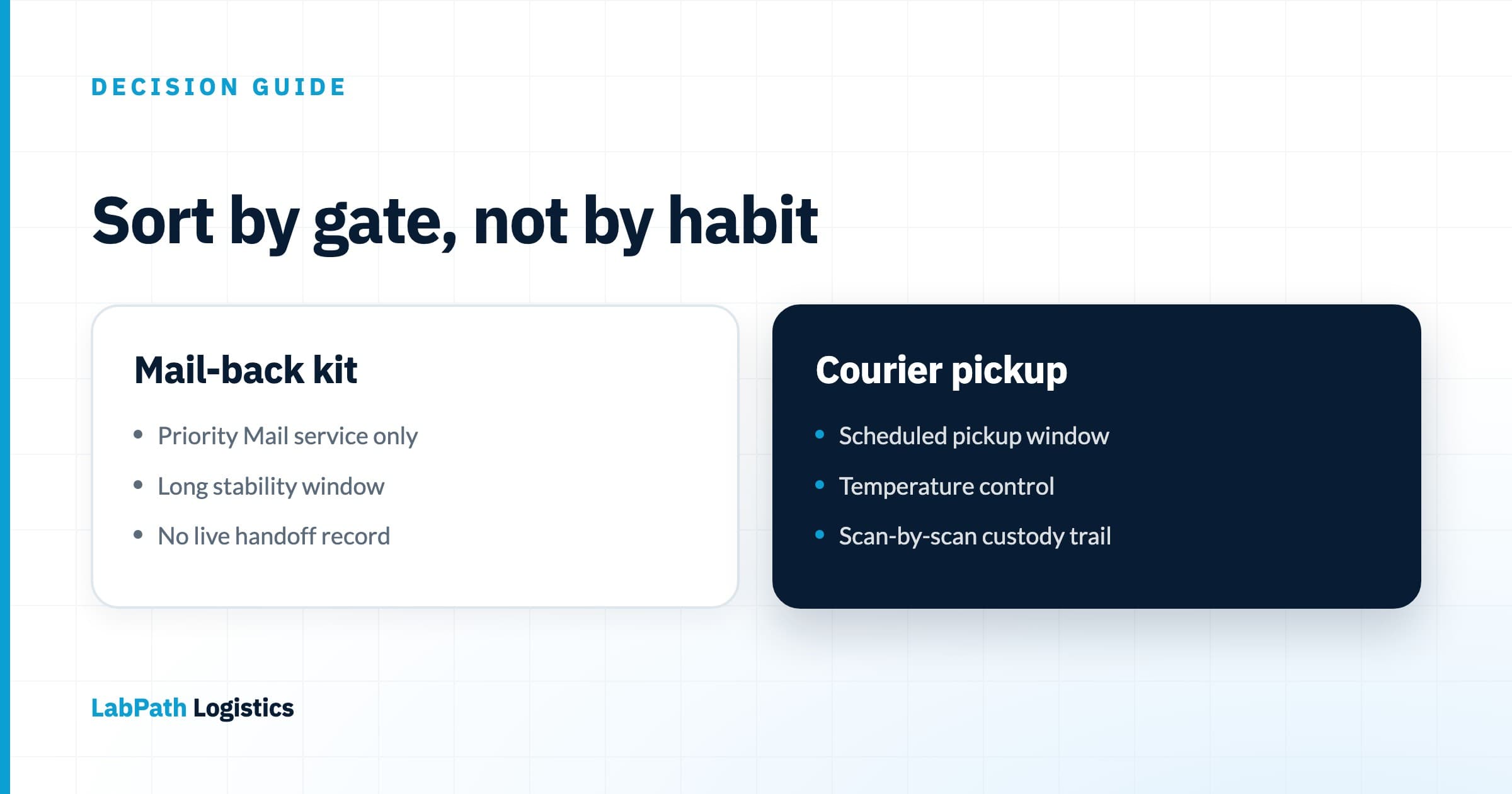
Use mail-back only for a specimen type your performing lab has approved for mail, with a stability window long enough to absorb delivery delays, packed to the USPS and DOT rules that apply. Use a courier when the window is short, the specimen needs controlled temperature, or you need a record of every handoff. Most clinics end up with both, assigned by specimen type, not by habit.
Priority Mail only
USPS Publication 52, section 346.321, allows domestic mailing of Category B (UN3373) diagnostic specimens only by Priority Mail or Priority Mail Express. Ground service is not allowed, and the package must follow triple packaging under 49 CFR 173.199.
What Is the Four-Gate Route Test?
The Four-Gate Route Test: save this and send it to your lab director
Run each specimen type through four gates. Gate 1, Rules: does your performing lab accept this type by mail, and is the package class (Category B or exempt specimen) one USPS will carry? Gate 2, Window: does the lab's written stability limit survive a weekend, a missed delivery day, or a Houston weather delay? Gate 3, Temperature: does the lab require a controlled range in transit that a mailed kit cannot show you? Gate 4, Evidence: if the specimen goes missing, can you prove where it was and who held it? A specimen type that fails any gate belongs on the courier path.
The gates are ordered by how cleanly they fail. A rules failure is binary. A window failure is a number you can read off the lab's collection manual. Temperature and evidence failures are the ones that surface only after something goes wrong, which is why they are last on the list and first in the post-mortem.
Gate 1: What Do the Mail and DOT Rules Actually Allow?
Start with the package class. For Category B specimens, USPS Publication 52 requires triple packaging under 49 CFR 173.199, with the shipping name "Biological Substance, Category B" and "UN3373" on the address side, an emergency contact name and phone number on the outer packaging, and Priority Mail or Priority Mail Express service. Primary receptacles are capped at 1 liter of liquid or 4 kilograms of solid, and a secondary packaging at 4 liters or 4 kilograms.
The same publication describes a separate class of exempt human specimens, such as routine non-infectious-disease tests, which are not regulated as hazardous materials but still must be triple packaged and marked "Exempt human specimen" with primary receptacles up to 500 milliliters or 500 grams. Which class a specimen belongs to is a classification decision for your lab and its compliance lead, not a front-desk judgment. Our Category B packaging guide walks through the packaging side in detail.
One more rule worth knowing: 49 CFR 173.199(e) says each person who offers or transports a Category B infectious substance must know its requirements. A mail-back program means the clinic staff packing the box are on the hook for that knowledge, so training belongs in the cost of the kit.
Gate 2: Does the Stability Window Survive the Slowest Delivery?
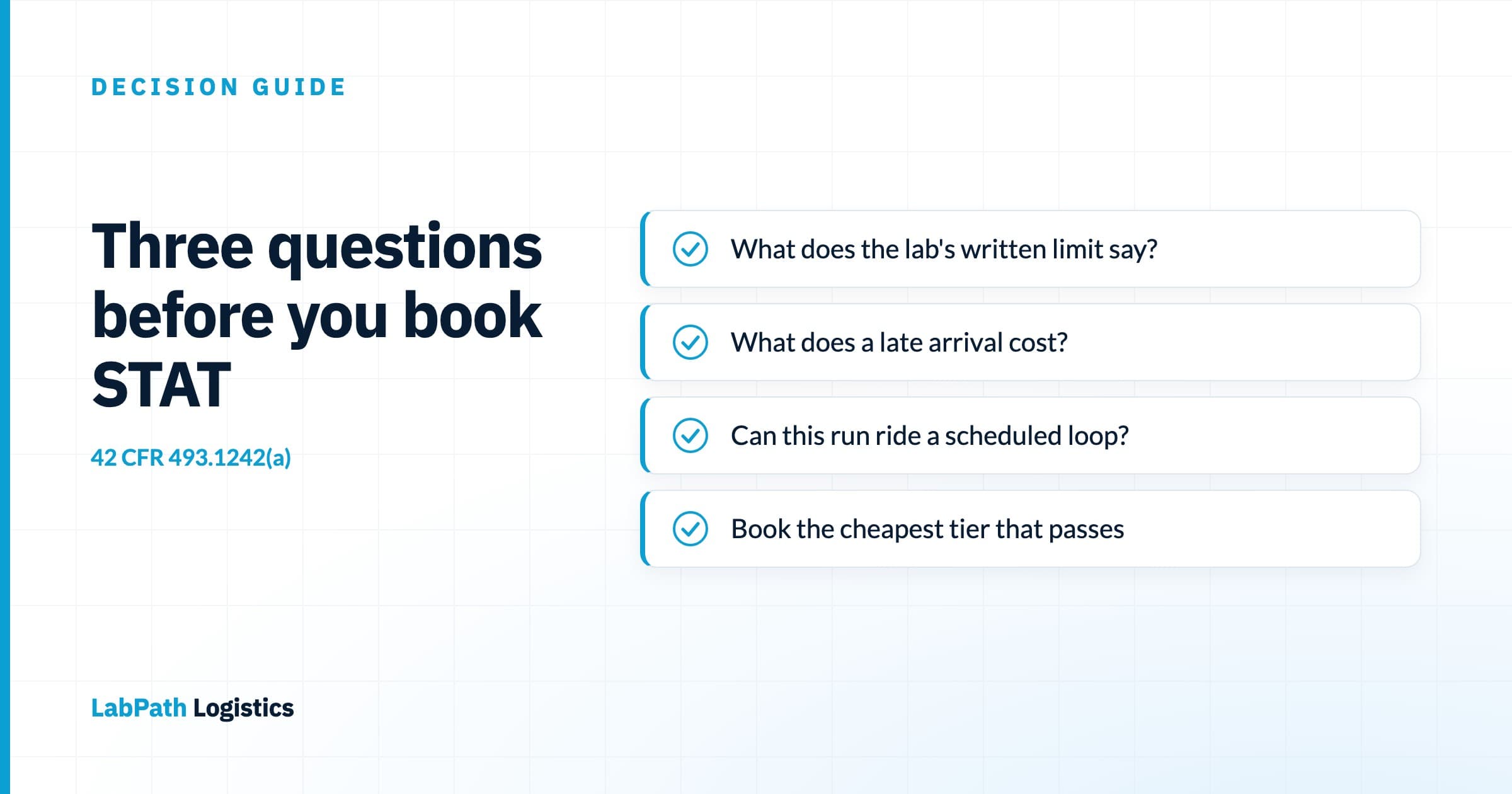
Under CLIA, 42 CFR 493.1242(a), a laboratory must establish and follow written procedures that include transport conditions and the acceptability of specimens. That written policy, not a vendor brochure, defines your window. Read the limit for each specimen type, then ask whether it still holds if the box ships Friday afternoon, sits through a weekend, or is delayed by a tropical storm. If the honest answer is "only when everything goes right," the specimen fails Gate 2. Our guide to the next-flight-out option covers the intermediate case where a specimen must leave Houston by air on a deadline.
Gates 3 and 4: Where Do Temperature and Evidence Decide It?
A mailed kit gives you a package that arrives or does not arrive. A courier run gives you a timeline: pickup scan, any transfer, drop-off scan, and the identity of the person who accepted the specimen. When your lab requires a controlled range in transit, or when a lost or late specimen would mean a recollection you cannot ask for, the timeline is the product. See our posts on chain of custody and lost specimens in transit for what the trail should contain.
- Collected in the clinic and needed by the lab the same day: courier path.
- Patient self-collected, stable, and lab-approved for mail: a mail-back kit can be the right path, if the instructions and packaging are built to the rules above.
- Collected at a patient's home or workplace by your staff or a partner: compare a scheduled stop against a kit, and read our guide on mobile phlebotomy courier planning.
- Outpatient-at-home programs with frequent samples: see hospital-at-home logistics.
A Houston Scenario: One Clinic, Three Specimen Types
A Houston-area internal medicine clinic ships three kinds of specimens: routine same-day blood draws, a self-collected kit its lab has approved for mail, and a time-sensitive culture. Run through the gates, the blood draws and the culture land on the courier path, because both fail Gate 2 or Gate 4 on a bad day. The approved kit passes all four gates and can stay on mail-back, with a standing rule that kits are not dropped on Friday afternoons. The point is not that mail is bad. The point is that the clinic can now write down why each specimen goes where it goes.
How Do You Cost Out Both Paths Fairly?
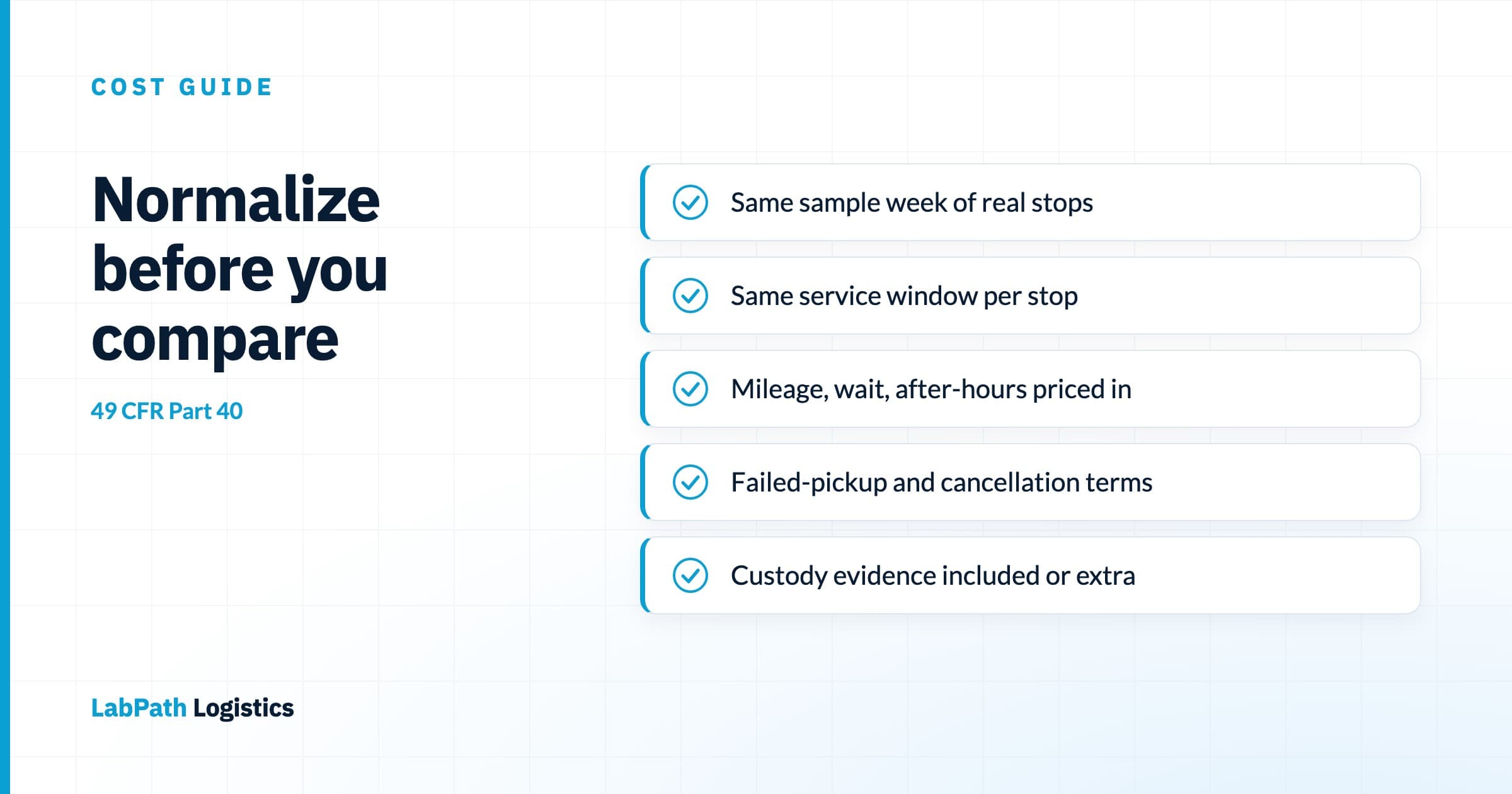
Price mail-back at its full cost: the kit, postage at the required Priority Mail class, staff time to pack and label, training, and the recollection risk when a package is late. Price courier pickup as a cost per completed stop, using the method in our quote comparison guide. Shared scheduled stops are cheapest when several specimens leave from the same site, so the fair comparison is a courier stop that carries everything, not one stop per specimen type.
If you want to test the courier side before moving anything, a 30-day pilot on one site and a few specimen types keeps the decision reversible.
LabPath Logistics is in early access for Greater Houston, and we make no fixed-minute pickup promise. The website's nonbinding rate card shows Same-Day from $39, Rush from $49, STAT from $95, shared scheduled stops from $38, and dedicated scheduled routes from $114, with mileage and handling adjustments; it is an estimate, not a booking quote, and the quote produced at booking is authoritative. Our booking model has no patient data fields, by design. Price a stop in the nonbinding estimator, review the services, or see what is verified today on the platform preview.
Frequently Asked Questions
Can you mail a clinical specimen with USPS?
Yes, in defined cases. USPS Publication 52 allows domestic mailing of Category B (UN3373) diagnostic specimens by Priority Mail or Priority Mail Express, packed in triple packaging under 49 CFR 173.199 and marked as the publication requires. Ground service is not allowed. Confirm with your performing lab that it accepts the specimen type by mail.
What is the difference between a Category B and an exempt human specimen?
Category B specimens are regulated as hazardous materials and need UN3373 marking and triple packaging under 49 CFR 173.199. Exempt human specimens, per USPS Publication 52, are routine tests not related to diagnosing infectious disease; they are not regulated as hazmat but still require triple packaging and an "Exempt human specimen" mark. Your lab decides which applies.
Is mail-back cheaper than a medical courier?
Not automatically. Kit and postage cost less per box than a dedicated courier run, but staff time, training, and the cost of recollecting a late or lost specimen belong in the total. A shared scheduled courier stop that carries several specimen types can narrow the gap.
Who decides how a specimen should be transported?
The performing laboratory sets acceptable transport conditions in writing, as required by CLIA at 42 CFR 493.1242(a). Clinics should follow the lab's collection manual and involve their medical director and compliance lead before changing how a specimen type travels.