Glucose Specimen Transport in Houston: Beat Glycolysis
October 4, 2026 · By LabPath Logistics Editorial Team, Medical Logistics Desk
Quick Answer
In an unseparated blood tube, cells keep consuming glucose after the draw, and glucose can fall by as much as 7% per hour. A faster courier cannot undo that. Protecting a glucose specimen in transport means stopping glycolysis at the clinic — using the stabilizing tube or separation step your receiving lab specifies — and then scheduling pickups around when tubes are actually ready.
Glucose is one of the most ordered tests in any Houston clinic, and one of the easiest to damage on the way to the lab. Glucose specimen transport has a problem most other analytes do not: the specimen changes inside the tube from the moment it is drawn, whether the tube is sitting on a counter, in a lockbox, or in a courier's cooler.
This guide is for clinic administrators, practice managers, and lab outreach teams. It explains what happens to glucose between draw and analysis, why the tube choice matters more than the drive time, and how to line up your pickup schedule with your lab's handling rules. It is logistics guidance only — your receiving lab's specimen requirements are the authority for your tests.
What Happens to Glucose in the Tube
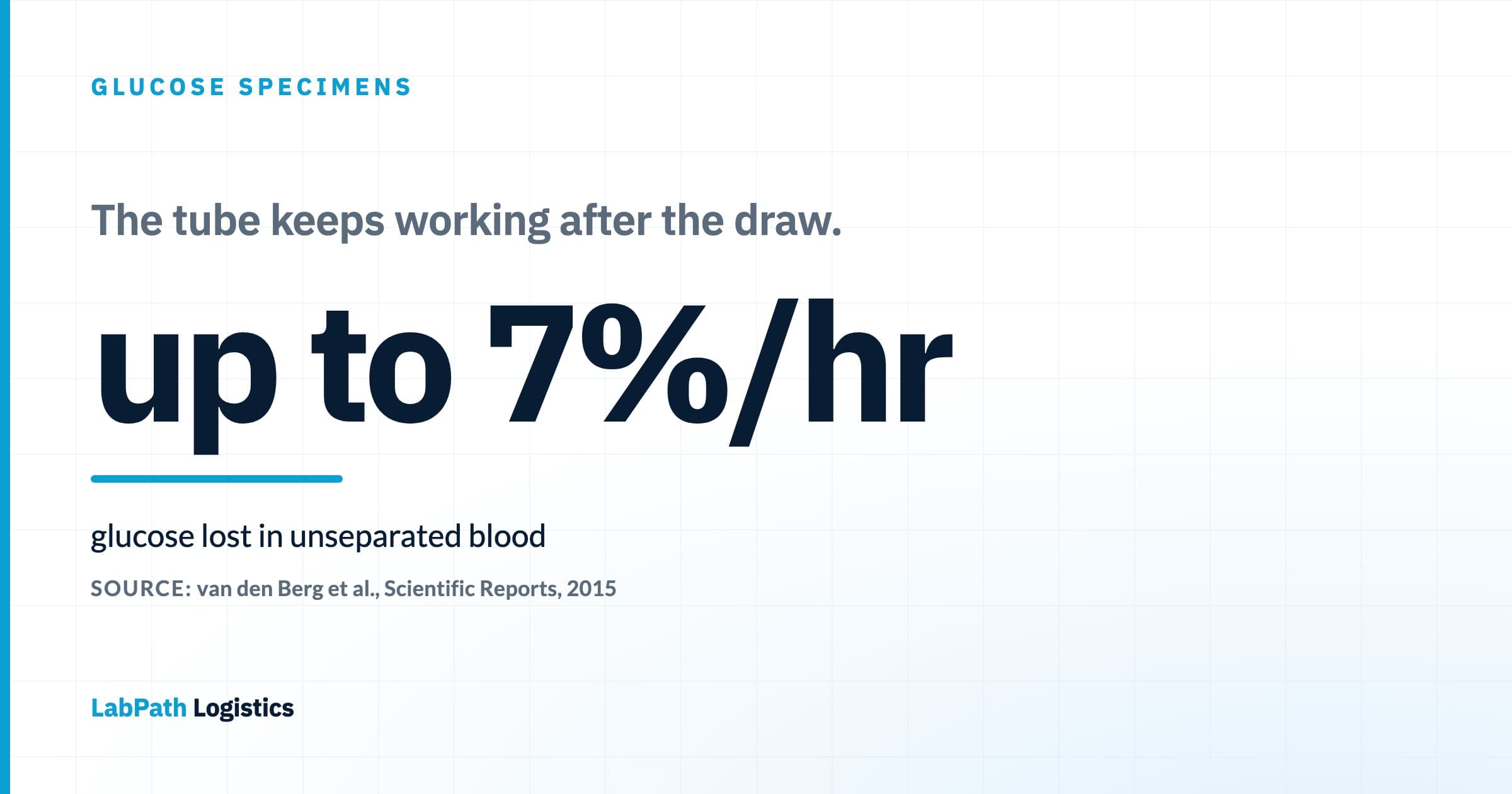
Blood cells are alive after collection, and they keep burning glucose for energy. This process, glycolysis, continues until the cells are separated from the plasma or something chemically stops it. Researchers writing in Scientific Reports note that in vitro glucose levels may drop as much as 7% per hour because of ongoing glycolysis.
Up to 7% per hour
In vitro glucose loss from ongoing glycolysis in unseparated blood (van den Berg et al., Scientific Reports, 2015)
For logistics, the important part is that the loss is time-driven. A tube that waits three hours for a pickup has been losing glucose for three hours before the courier ever arrives. The result is not a rejected specimen — the tube looks fine and gets tested — but a falsely low number that nobody downstream can see.
Why the Gray-Top Tube Is Not Instant
Many clinics assume a sodium fluoride (gray-top) tube freezes glucose at the moment of the draw. It does not. Fluoride blocks an enzyme far down the glycolysis pathway, so the steps above it keep running until they exhaust their substrate. The same Scientific Reports paper notes that inhibiting that enzyme stabilizes glucose in the long term but does not prevent a drop during the first hours after phlebotomy.
That gap is why the field's guidance moved. In August 2023, the Association for Diagnostics and Laboratory Medicine and the American Diabetes Association published updated laboratory guidelines for diabetes (Sacks et al., Clinical Chemistry, 2023). As CAP Today summarized, the document recommends collection tubes containing citrate buffer to minimize glucose breakdown, and when those are not available, placing the tube immediately in an ice-water slurry and centrifuging to remove the cells within 15 to 30 minutes.
Your lab decides the tube, not your courier
Tube type, separation timing, and acceptable delay are set by the receiving lab's specimen requirements and validated on its analyzers. Before you change anything, ask the lab which glucose tube it accepts and how long it allows between draw and separation.
Where Transport Fits — and Where It Does Not
A courier can shorten the time between pickup and the lab. It cannot shorten the time between draw and pickup, and that is often the bigger window. If a clinic draws fasting glucose at 7:30 a.m. and the only pickup is at 1 p.m., a 20-minute drive to the lab is a small fraction of the total delay.
- Unseparated tube, long wait: glucose loss is happening in the clinic, and faster driving barely helps.
- Separated or stabilized specimen: the clinic has stopped the clock, and transport becomes about temperature and custody.
- Ice-slurry tubes: these need separation within the lab's window, which usually means on-site processing — not a cooler ride across town.
Temperature still matters once a specimen is stabilized. Houston heat speeds up chemical changes in most specimens, and a cool-but-not-frozen lane protects separated serum and plasma. Our specimen transport temperature guide explains the refrigerated, frozen, and ambient lanes, and our Houston heat guide covers vehicle and lockbox exposure.
A Houston Scenario: The Morning Fasting Draws
Picture a primary care clinic in Pearland that draws most of its fasting labs between 7 and 10 a.m. Its reference lab is in the Texas Medical Center, and the clinic has one standing pickup at 2 p.m. The clinic uses gray-top tubes for glucose and does not centrifuge on site.
The 7 a.m. tubes wait seven hours before pickup. Nothing about the courier run is wrong, yet the glucose results from the earliest draws are the least reliable of the day. The fix is a decision the clinic makes with its lab: switch to the lab's stabilized tube or separate on site within the lab's window, and add a late-morning pickup so the first batch of the day does not sit until afternoon. Our specimen pickup schedule guide walks through sizing pickups to draw volume.
A Glucose Handling Checklist for Clinics
- Get the lab's written requirement. Confirm the accepted tube type, maximum time from draw to separation, and storage temperature for glucose.
- Match the tube to your pickup reality. If tubes will wait hours, use the stabilization approach the lab specifies rather than relying on a gray-top alone.
- Record draw time on the requisition. The lab can only judge delay if it knows when the clock started.
- Separate on schedule if you centrifuge. Build the spin into the draw workflow so it does not wait for a lull.
- Align pickups with draw peaks. Add a pickup after your heaviest draw window instead of one end-of-day run.
- Keep separated specimens in the lab's temperature lane. Cool, not frozen, unless the lab says otherwise.
Why This Matters at Houston Volume
Glucose testing is not a niche workflow in Texas. The Texas Department of State Health Services reports, from 2023 Behavioral Risk Factor Surveillance System data, that an estimated 2.97 million Texas adults — 12.7% — have been diagnosed with diabetes (Texas Diabetes Council data tables). Every one of those patients is monitored with lab work, and a large share of that work starts in outpatient clinics that rely on couriers.
A systematic low bias from routine delays does not trigger a rejection, so it rarely shows up in an incident log. That is exactly why it is worth fixing in the workflow rather than waiting for a complaint. For the broader picture on delays and results, see our lab turnaround time guide and our specimen rejection guide.
Frequently Asked Questions
How fast does glucose drop in a blood sample that is not separated?
Glycolysis continues after collection, and published research reports in vitro glucose declines of as much as 7% per hour in unseparated blood. The loss depends on time and temperature, so the delay between draw and separation matters most.
Does a gray-top sodium fluoride tube stop glucose loss immediately?
No. Fluoride blocks a late step of glycolysis, so earlier steps keep consuming glucose for the first hours after the draw. The 2023 ADLM/ADA guidelines recommend citrate-buffered tubes, or an ice-water slurry with centrifugation within 15 to 30 minutes when those tubes are unavailable.
Can a faster courier fix low glucose results from delayed specimens?
Only partly. A courier shortens the time from pickup to the lab, but glucose loss in an unseparated tube starts at the draw. Stabilizing or separating the specimen at the clinic, and scheduling pickups after draw peaks, does more than driving faster.
What should a Houston clinic ask its reference lab about glucose specimens?
Ask which tube type the lab accepts for glucose, the maximum time allowed from draw to separation, the required storage and transport temperature, and whether draw time must be recorded on the requisition.