Medical Courier Pilot Program: A 14-Day Houston Test
October 6, 2026 · By LabPath Logistics Editorial Team, Medical Logistics Desk
Quick Answer
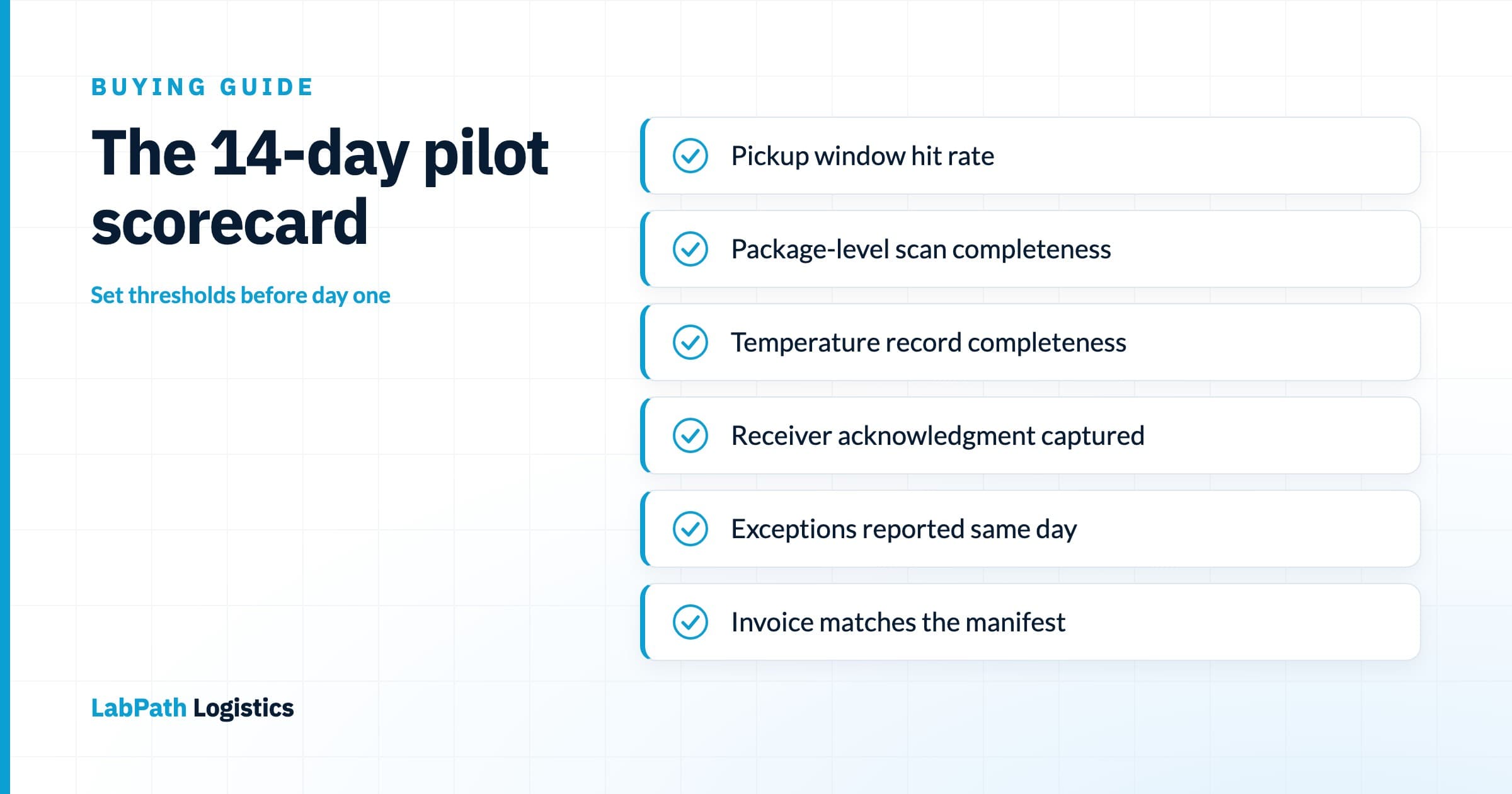
A medical courier pilot is a short, scoped trial, typically 10 business days on one route, judged against a scorecard you write before day one. Measure pickup-window hits, package-level scan completeness, temperature-record completeness, receiver acknowledgment, exception reporting, and invoice accuracy. A courier that will not be measured on those is telling you something before you sign.
Most Houston labs choose a courier the way they buy insurance: a sales call, a rate sheet, a reference or two, and a twelve-month contract. The first real evidence arrives in month two, when a STAT is late and everyone discovers what the paper promised. A medical courier pilot program in Houston turns that around. You get the evidence first and make the commitment second.
This guide is for lab managers, clinic administrators, and outreach coordinators who are comparing couriers or considering a switch. It gives you a scorecard you can copy, a two-week structure, and the questions that expose a weak courier before a contract does. If you only take one thing: write the pass/fail thresholds before the first pickup, not after.
Why Pilot Before You Sign
Specimen logistics is where lab quality quietly leaks. A review summarized by Westgard QC of Plebani's work on laboratory errors reported that roughly 60% of errors occur in the pre-analytical phase, against about 15% analytical and 25% post-analytical. Collection, labeling, handling, and transport sit in that first bucket, and a courier touches most of it.
~60%
Share of laboratory errors in the pre-analytical phase, per Plebani's error-distribution work as summarized by Westgard QC
A sales deck cannot show you your own routes, your own dock hours, or your own tube types. Two weeks of real runs can. Our guides to switching medical couriers and the RFP checklist cover the paperwork side. The pilot covers the part paper cannot: behavior.
The Six-Line Pilot Scorecard
Write these down, assign a threshold to each, and share them with the courier on day one. A courier confident in its operation will welcome the scorecard. Agree on what counts as a pass before the pilot starts, because numbers chosen afterward drift toward whatever the data happened to show.
- Pickup window hit rate: of all scheduled and on-demand pickups, how many were completed inside the window you agreed? Count late and missed runs separately.
- Package-level scan completeness: was every package scanned at pickup and drop-off, not just the stop? A stop-level signature proves the courier was there; a package scan proves the specimen was. See our chain of custody guide.
- Temperature record completeness: for refrigerated and frozen runs, is there a usable record from pickup to handoff, with a plan for excursions? Our temperature guide lists the ranges.
- Receiver acknowledgment: did a named person at the destination accept each handoff? Unacknowledged drop-offs are the weakest link in most chains.
- Exception reporting: when something went wrong, how fast did you hear, and from whom? The right answer is that the courier told you before you asked.
- Invoice accuracy: does every line on the invoice match a manifest entry? Our invoice audit guide shows what to check.
Save and send this
Copy the six lines above into a shared note and send it to your lab director and your procurement lead. A pilot only works if the people who feel the pain and the people who sign the contract agree on the scorecard first.
A Two-Week Structure That Fits a Real Lab
Days 1–2: Scope Small
Pick one route and one service level, such as a daily scheduled sweep from two clinics to your main lab. Keep your current courier running everything else. A small scope limits risk and makes the data readable. Add one STAT test run if you can, since that is where couriers differ most.
Days 3–12: Run and Record
Keep a simple log for each run: promised window, actual pickup, scan status, temperature record, receiver name, and any exception. Have your accessioning team flag anything that arrives damaged, mislabeled, or out of range. If the pilot route also carries something irreplaceable, such as a biopsy, run it through your normal separate-bag process so the trial never puts the patient at risk.
Days 13–14: Review Against Your Thresholds
Sit down with the courier and walk the scorecard line by line. Look for patterns, not single misses: one late pickup in 40 is a conversation, but five late pickups on Tuesdays is a staffing problem. Ask what they changed during the pilot when something went wrong. How a courier reacts to a miss tells you more than the miss itself.
Paper Still Comes First: BAA, Training, Insurance
A pilot is a trial of performance, not a loophole around compliance. If the courier will handle protected health information on your behalf, HIPAA requires a written business associate agreement under 45 CFR 164.504(e) before it does. Packages with a requisition or labeled tube can qualify. Ask for the BAA, proof of insurance, and a description of driver training, including how the courier handles bloodborne-pathogen exposure under OSHA's 29 CFR 1910.1030, before the first pickup. Our insurance guide explains what to request.
A Houston Scenario: The Tuesday Problem
Imagine a reference lab near the Texas Medical Center piloting a courier on a loop through three Katy and Energy Corridor clinics. Pickups hit the window on Monday, Wednesday, and Thursday. On Tuesday, a clinic's afternoon sweep runs 40 minutes late three weeks in a row. On paper the courier's on-time rate looks fine. On the scorecard, it is a pattern the lab can raise on day 13, ask the courier to fix, and re-test before any contract exists. That conversation is only possible because the pilot had a log.
What a Pilot Should Cost
A pilot should be priced like the service you would actually buy, at the same rate card, with no setup or lock-in. Be wary of a courier that discounts the trial heavily, since you are then measuring the honeymoon rather than the service. For context on how Houston pricing works, see our cost breakdown and the SLA guide.
Frequently Asked Questions
What is a medical courier pilot program?
A short, scoped trial of a courier on one route and service level, usually 10 business days, judged against a scorecard written in advance. It lets a lab or clinic test pickup reliability, scan completeness, temperature records, and billing before signing a long contract.
How long should a medical courier trial last?
Two weeks, or about ten business days, is enough to see weekday patterns such as a recurring late pickup, without putting much volume at risk. If your lab has weekend or after-hours needs, include at least one of each.
Do I need a BAA before a courier pilot?
If the courier will handle protected health information for you, yes. HIPAA requires a written business associate agreement before a business associate handles PHI on your behalf under 45 CFR 164.504(e). A trial does not change that, so sign the BAA before the first pickup.
What should I measure during a medical courier trial?
Six things: pickup window hit rate, package-level scan completeness, temperature record completeness, receiver acknowledgment, how quickly exceptions are reported, and whether invoices match the manifest. Set a pass threshold for each before day one.