Lab Courier vs Independent Medical Courier in Houston
October 9, 2026 · By LabPath Logistics Editorial Team, Medical Logistics Desk

Quick Answer
A reference lab's courier carries specimens to that lab, on that lab's schedule, with its cost folded into your test bill. An independent medical courier carries anything to any destination on windows you set, with a separate invoice. Count the places your items go each week. One destination favors the bundled courier. More than one usually needs your own.
The courier that already stops at your clinic every afternoon is not your courier. It belongs to the reference lab, it runs to the reference lab, and its cost is inside the price of every test you send there. That is a reasonable deal for a clinic with one send-out destination. It stops being one the day you have two. For a Houston clinic deciding between the lab's courier and an independent medical courier, the question is not which is cheaper. It is how many places your specimens, supplies, and documents actually go.
This guide is for clinic administrators, practice managers, and lab directors who are about to add a destination, change reference labs, or renegotiate a courier agreement. It explains how the bundled courier works, where it quietly creates compliance exposure, and gives you the Destination Count, a six-line worksheet that makes the decision obvious.
How Does a Reference Lab's Courier Actually Work?
National and regional reference labs run their own logistics networks, and those networks are enormous. Quest Diagnostics' fact sheet describes a logistics network of over 4,000 courier vehicles and nearly 20 aircraft making more than 73,000 stops daily. That scale is the point. A network like that is engineered to feed specimens into the lab's intake on the lab's processing schedule.
73,000+
Daily courier stops in one national reference lab's logistics network, per Quest Diagnostics' published fact sheet
For your clinic, that means three things. The route is designed around the lab's cutoffs, not your closing time. The courier carries specimens to that lab and supplies from it, and nothing else. And there is no invoice for the service, because its cost sits inside the fee schedule you already pay. Our send-out testing guide covers how those cutoffs shape turnaround time.
None of that is a flaw. It is a well-run service doing exactly the one job it was built for. The trouble starts when a clinic treats it as a general-purpose courier.
What Can't the Lab's Free Courier Carry?
This is where the decision becomes a compliance question, not just a scheduling one. The federal Anti-Kickback Statute makes it a problem for a lab to give a referring physician anything of value in a way that could induce referrals. The HHS Office of Inspector General has said this plainly for three decades. Its 1994 Special Fraud Alert on clinical laboratory arrangements states that whenever a laboratory offers a referral source "anything of value not paid for at fair market value, the inference may be made that the thing of value is offered to induce the referral of business."
The same 1994 alert lists specific inducements OIG considers suspect. One of them is directly about pickup: "Free pick-up and disposal of bio-hazardous waste products (such as sharps)." Another describes lab-placed phlebotomists, who are acceptable when they only collect specimens for the lab, but implicate the statute when they perform "clerical or medical functions not directly related to the collection" of those specimens.
OIG returned to the theme in its June 25, 2014 Special Fraud Alert on laboratory payments to referring physicians, repeating that "arrangements providing free or below-market goods or services to actual or potential referral sources are suspect and may violate the anti-kickback statute, depending on the circumstances." It also warned that arrangements which "carve out" federal program patients do not reduce the risk, because physicians "typically wish to minimize the number of laboratories to which they refer for reasons of convenience and administrative efficiency."
The courier version of the phlebotomist rule
A lab's courier picking up specimens bound for that lab is the lab's own cost of doing business. The same driver hauling your sharps, moving charts between your two sites, dropping a biopsy at a hospital pathology department, or running supplies to your satellite office is doing work for you, not for the lab. That is the shape OIG describes. This is not legal advice. If any of it sounds familiar, ask compliance counsel before the next contract renewal, not after.
There is a practical edge too. The 2014 alert notes that Medicare already reimburses physicians for processing and packaging specimens for transport through a bundled payment. In other words, you are compensated for getting the specimen ready. The lab is responsible for getting it to the lab. Everything that goes anywhere else is yours to arrange and yours to pay for. Our HIPAA and courier guide covers the separate question of when a courier is a conduit and when it is a business associate.
What Is the Destination Count?
The Destination Count is a six-line worksheet. Fill it in for one typical week and the answer usually writes itself.
- Reference lab destinations: how many different labs receive your routine send-outs? Each one has its own courier, cutoff, and supply loop.
- Hospital or pathology destinations: biopsies, surgical specimens, frozen sections, and anything a hospital-based lab reads for you.
- Pharmacy destinations: compounded preparations, infusion drugs, discharge medications, or returns to a pharmacy.
- Your own sites: records, supplies, instruments, and interoffice items moving between your locations.
- Off-schedule runs: STAT specimens, missed-pickup recoveries, and anything collected after the bundled courier's last stop.
- Non-lab items: sharps and waste pickup, equipment to service vendors, documents to payers or attorneys.
Add the lines. A total of one means the bundled courier is doing its one job and you should let it. A total of two or more means you have runs that no reference lab's courier should be carrying, and someone is either doing them in a personal car or stretching a service that was never priced for them. Our in-house vs. courier guide covers why the personal car is the most expensive option on the list.
A Houston Scenario: The Pearland Multi-Specialty Clinic
Picture a two-site multi-specialty group along Broadway in Pearland. Routine chemistry and hematology go to a national reference lab, whose courier arrives at 3:30 p.m. each weekday. Dermatology biopsies go to a hospital pathology department in the Texas Medical Center. A weekly infusion schedule depends on a compounding pharmacy across town. Supplies, signed records, and the occasional instrument move between the two sites. The Destination Count is four, and only one of those destinations has a courier.
What usually happens is that a medical assistant drives the biopsies on the way home, the pharmacy drop is whoever is free on Thursday, and the lab courier is asked once in a while to "just grab" the interoffice bag. The clinic has three unpriced courier operations and one that is quietly borrowing a service it does not own. An independent courier running a single scheduled afternoon loop replaces all three with one invoice, one custody record, and one set of pickup windows the clinic controls. Our pickup schedule guide shows how to size that loop.
Houston's lab map is also shifting under clinics' feet. Houston Methodist says its internally operated laboratory service now covers sites including Pearland, Sienna, and League City, noting that "each year, our physicians send thousands of lab orders to commercial providers" that it aims to bring in-house. When a health system moves testing, the bundled courier moves with it, and the clinic's destination list changes overnight. A courier you own does not care which lab wins that contract.
Lab Courier vs Independent Courier: The Side-by-Side
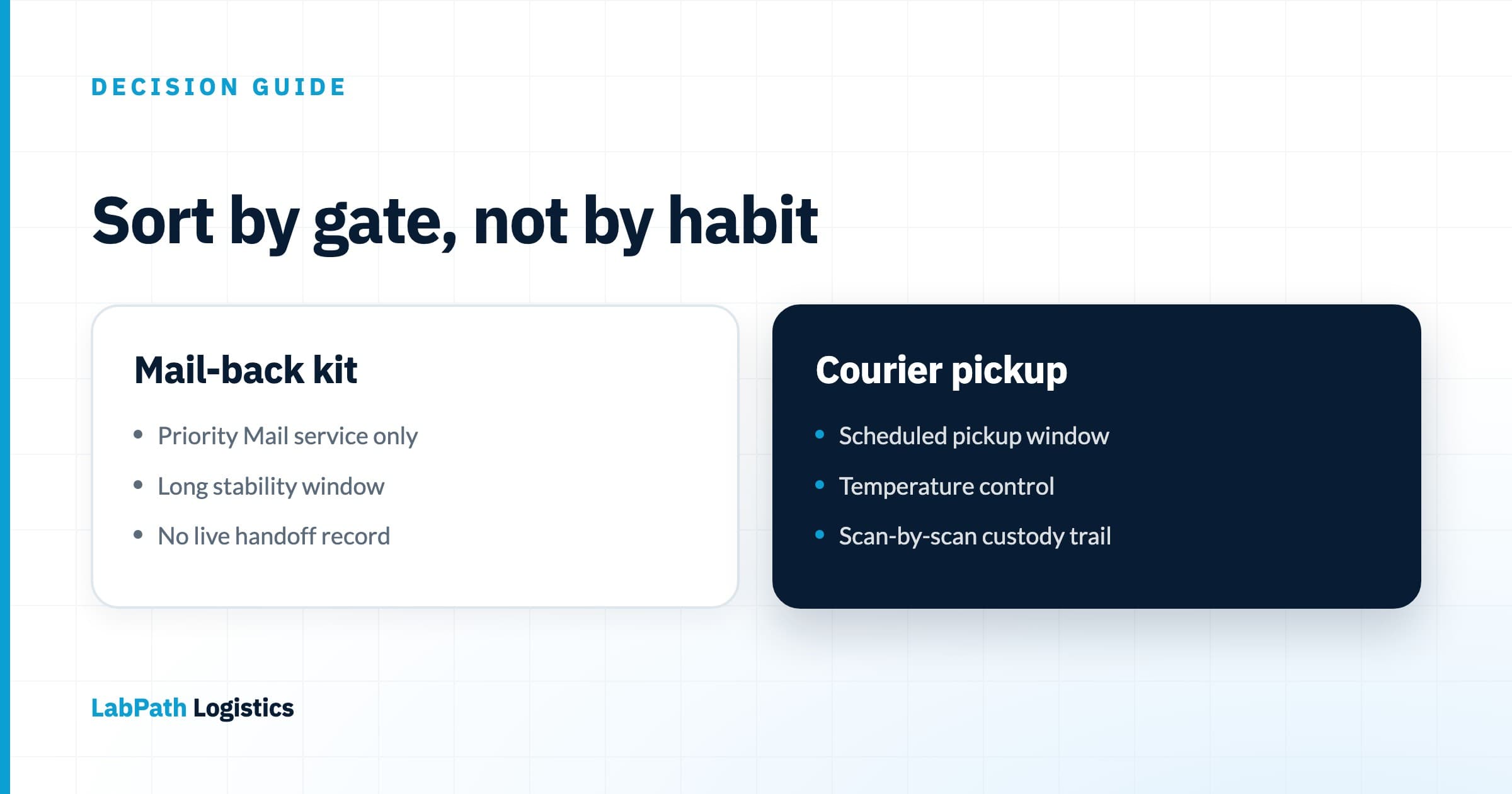
- Destinations: the lab's courier serves one. An independent courier serves any address you give it, including your own second site.
- Pickup windows: the lab's route is set around its intake cutoffs. An independent courier's windows are written into your agreement.
- Cost visibility: the lab's courier has no line item and cannot be audited. An independent courier produces an invoice you can check stop by stop, which our invoice audit guide walks through.
- Custody records: the lab's scan trail lives in the lab's system. An independent courier's package-level scans and receiver acknowledgments are yours, as our chain of custody guide explains.
- Switching risk: change reference labs and the bundled courier disappears the same day. An independent courier simply gets a new destination.
- Compliance posture: the lab's courier should carry only that lab's specimens and supplies. An independent courier can carry everything else without implicating the lab relationship.
Keep the bundled courier for what it does well. The decision is about everything it was never meant to do. If you are already weighing a new reference lab, our switching couriers guide and the upcoming 2027 Medicare lab fee changes are worth reading together, because both change who pays for the pickup.
How Should a Clinic Price an Independent Courier?
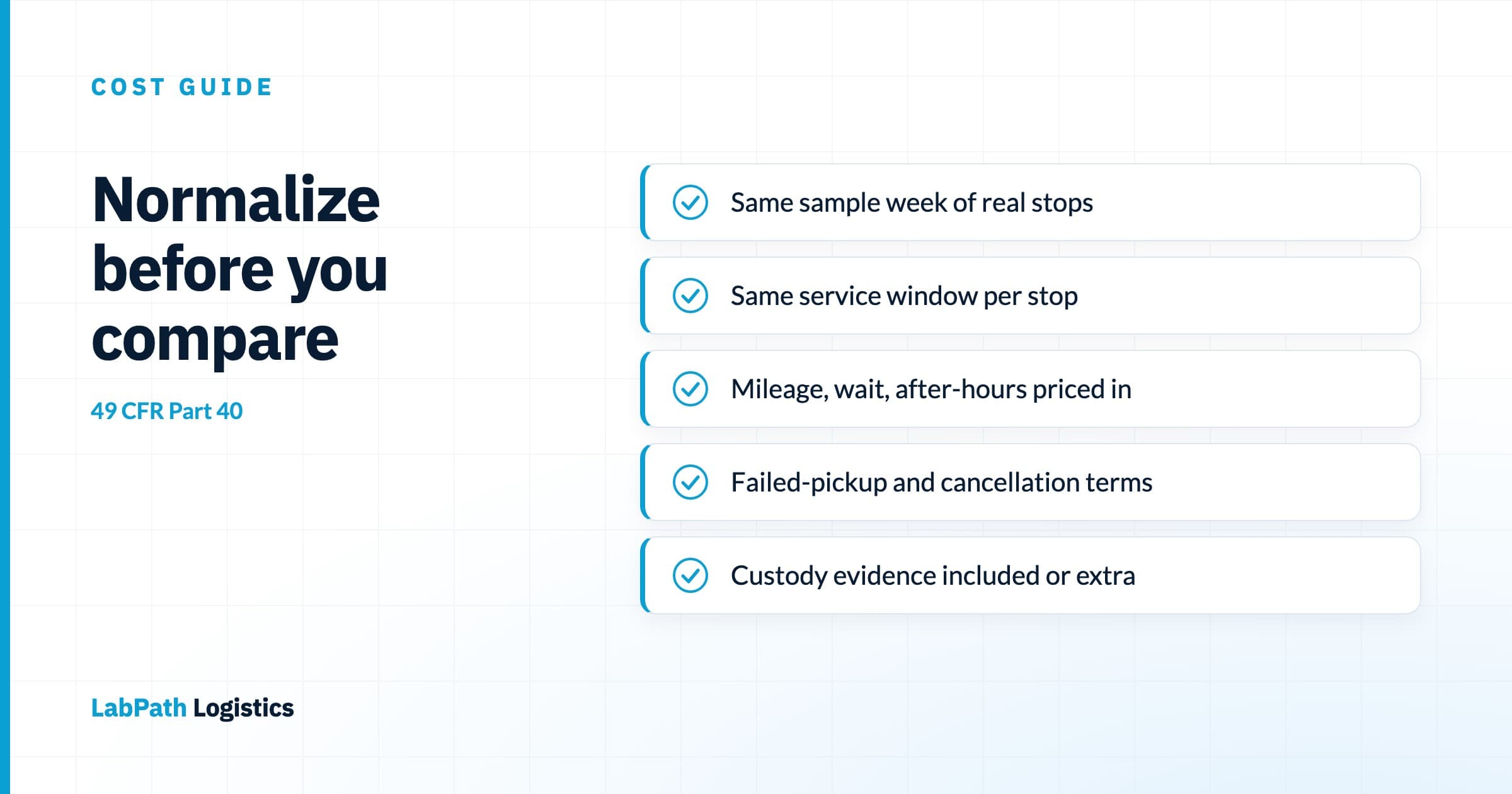
Price the runs you are already doing, not a hypothetical. Take lines two through six of your Destination Count, list each run with its frequency, and price it two ways: as a shared scheduled stop on a route, and as an on-demand call. Most clinics find that a scheduled loop covers the predictable runs and an on-demand option covers the rare STAT. The LabPath estimator gives a nonbinding estimate for both without signup, and our services page describes the planned service levels.
Save and send this
Forward the six Destination Count lines to your practice manager and compliance officer with one question: "Which of these runs is the reference lab's courier carrying for us today?" Anything on lines two through six is a run to price separately and, if it is currently on the lab's truck, a conversation to have with counsel.
Before signing anything, test the candidate on your real loop. Our 14-day pilot scorecard measures on-time windows and receiver acknowledgment, and our RFP checklist lists the insurance, training, and custody questions to ask up front.
Frequently Asked Questions
Is the reference lab's courier really free?
There is no separate invoice, but the cost is inside the test fees you already pay. The service is also limited to specimens going to that lab and supplies coming from it. Anything bound for another destination is a run you still have to arrange and pay for.
Can my clinic use the lab's courier to move items between our offices?
That is a question for compliance counsel. HHS OIG has long treated free services from a laboratory to a referring physician as potential inducements under the Anti-Kickback Statute, and its 1994 alert lists free biohazardous waste pickup as a suspect inducement. Work that benefits your practice rather than the lab is the shape OIG describes.
When does a clinic need an independent medical courier?
When specimens, medications, supplies, or documents routinely go to more than one destination, or when items are collected after the bundled courier's last stop. Count your destinations for one week. More than one usually means you need a courier you control.
What happens to courier service if we switch reference labs?
The outgoing lab's courier stops coming when the relationship ends, and the new lab's route starts on its schedule, not yours. An independent courier is unaffected by the switch. It simply gets a new destination address for the same scheduled loop.