Pap Test Specimen Transport in Houston: Skip STAT, Add Shade
October 17, 2026 · By LabPath Logistics Editorial Team, Medical Logistics Desk
Quick Answer
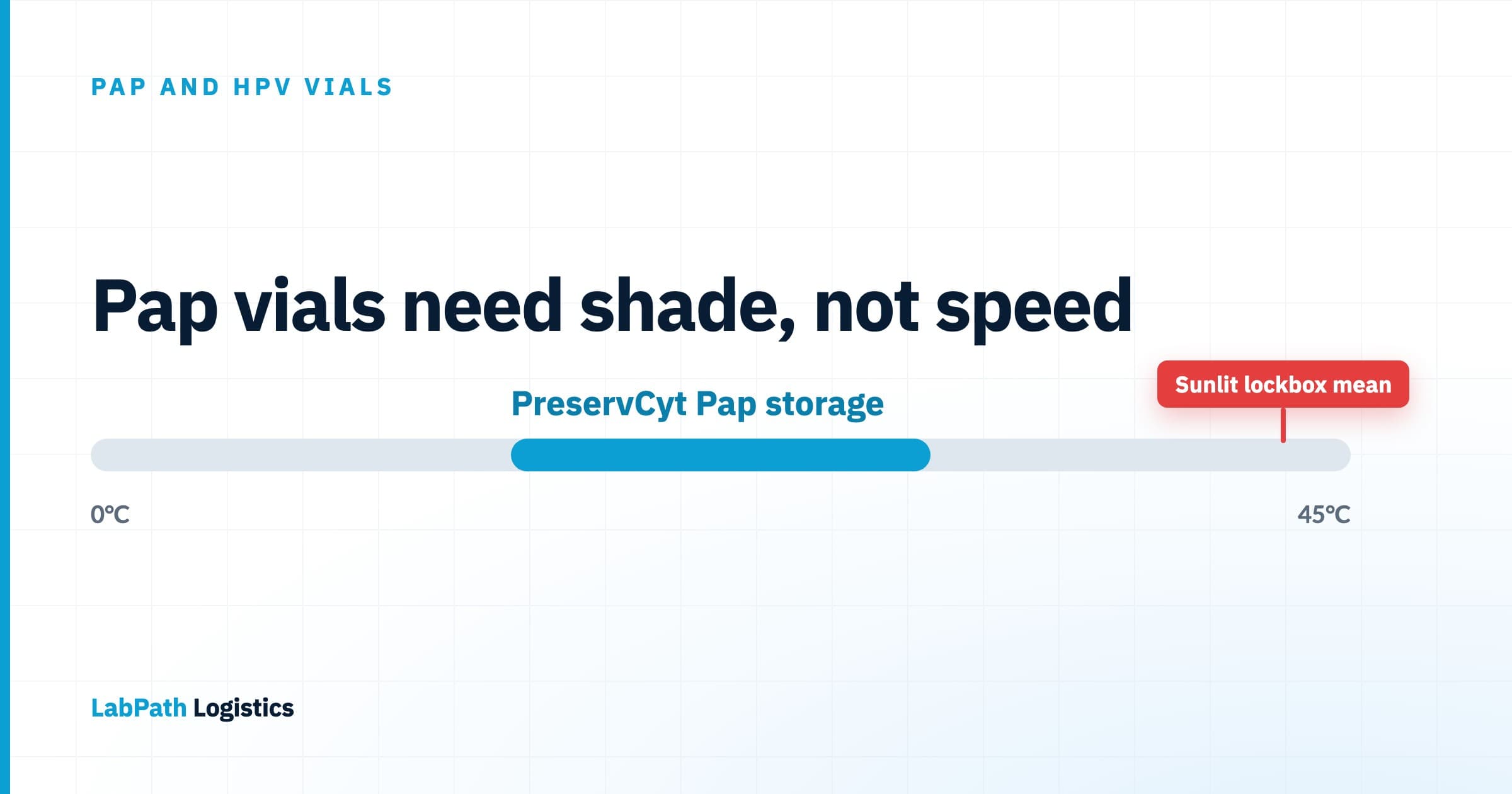
Pap test vials do not need STAT delivery. ThinPrep PreservCyt vials for Pap testing are labeled for storage at 15 to 30 °C for up to six weeks, so the risk is heat, not time. Ship them on a scheduled daily route, keep them out of sunlit lockboxes and parked cars, and follow your performing lab's stability table.
Most Houston clinics treat Pap test specimen transport like any other lab pickup: get it out the door fast. That instinct spends money in the wrong place. A liquid-based Pap vial is one of the most forgiving specimens on your counter when it comes to time, and one of the least forgiving when it sits in a hot car. The right courier plan for Pap and HPV vials is a scheduled route with a shade rule, not a STAT run.
This guide is for OB-GYN, family medicine, and women's health practice managers who send cytology to a reference lab. It covers what the vial manufacturer actually says, where Houston heat turns a six-week specimen into a rejected one, and a six-line check we call the Ceiling Check that you can hand to your front desk today.
How Long Is a ThinPrep Pap Vial Stable?
Longer than most staff assume. Hologic's ThinPrep 2000 System instructions for use state that PreservCyt Solution with a cytologic sample intended for ThinPrep Pap testing must be stored between 15 °C (59 °F) and 30 °C (86 °F) and tested within six weeks of collection. The same document gives a different window for some other assays run from the vial, which is why your performing lab's own stability table always wins.
15–30 °C
labeled storage range for PreservCyt vials intended for ThinPrep Pap testing, with testing within six weeks of collection (Hologic, ThinPrep 2000 System Instructions for Use, MAN-02624-001)
Read that range from both ends. The ceiling is 86 °F, which a Houston parking lot passes most of the year. The floor is 59 °F, which means a Pap vial does not belong on ice packs or in a refrigerated tote alongside your chemistry tubes. Our specimen transport temperature guide explains why mixed-temperature bags cause this exact problem.
What About SurePath Vials and HPV Testing?
SurePath is the other common liquid-based system, and it is not a niche case. Tardif and colleagues, writing in PLoS One in 2016, noted that roughly 30% of U.S. HPV testing is performed on cervical samples collected in SurePath. Stability for SurePath depends heavily on which test the lab runs. Performing-lab catalogs list room-temperature limits ranging from about one week to six weeks; Duke's HPV catalog entry, for example, lists 42 days ambient or refrigerated and warns that longer storage may affect detection.
~30%
approximate share of U.S. HPV testing performed on cervical samples collected in SurePath preservative (Tardif et al., PLoS One, 2016)
The logistics lesson is the same for both systems: time is generous, temperature and labeling are not, and the lab's catalog is the authority. Print the stability line for each vial type you use and tape it inside the pickup cabinet.
Where Does Houston Heat Actually Hit a Pap Vial?
Not usually on the road. A courier vehicle with working air conditioning holds a vial well inside its range. The exposure happens in the waiting points: the exterior lockbox, the staff member's car between offices, and the courier's parked vehicle during a long multi-stop route. Lockbox heat has been measured directly. In a summer study in the Mid-Atlantic, Dibbern, Pierre, and Wiencek in the American Journal of Clinical Pathology recorded a mean of 42.6 °C inside a sunlit lockbox with no cold packs.
42.6 °C
mean temperature inside a sunlit summer lockbox with no cold packs, well above the 30 °C PreservCyt Pap ceiling (Dibbern et al., American Journal of Clinical Pathology, 2021)
That study was not in Houston, and Houston's warm season runs longer. Our lockbox guide covers placement and cold-pack rules, and our Houston heat guide covers the vehicle side. For Pap vials the fix is simpler than for blood: shade and room temperature, never ice.
The Ceiling Check: Six Lines for Every Pap and HPV Pickup
CLIA requires the performing laboratory to have written policies for specimen labeling, preservation, and transport conditions under 42 CFR 493.1242, and to record the date and time it receives each specimen. The Ceiling Check turns those lab-side rules into six things your clinic and courier control.
The Ceiling Check: save and send to your lab director
(1) Vial type and its limits are posted at the pickup point, copied from the performing lab's catalog. (2) Pap vials ride at room temperature, never on ice and never frozen. (3) No vial waits in a sunlit lockbox or a parked car; indoor pickup or a shaded, insulated box only. (4) Two patient identifiers on the vial match the requisition before it leaves the room. (5) Cytology rides a scheduled daily route; vials are not held for weekly batching. (6) The courier's record shows pickup time, handoff time, and the lab's receipt time.
Line four matters as much as the temperature lines. A perfectly kept vial with a mismatched label is still a rejected specimen and a patient recall. Our specimen labeling guide shows where those mismatches start at the front desk.
A Houston Scenario: The Friday Pap Bag
A women's health practice in west Houston sends cytology to a reference lab near the Texas Medical Center. Its courier comes once a day at 4:30 p.m. On Fridays the last patients run late, so staff leave the Pap bag in the exterior lockbox for a Saturday pickup that the lab-provided courier sometimes skips. By Monday the bag has spent a weekend in a metal box facing a west wall.
The vials were never at risk of running out of time. They were at risk of passing 86 °F. The practice changes three things: Friday vials stay indoors at room temperature until Monday's first pickup, the lockbox is reserved for refrigerated tubes with cold packs, and cytology moves to a scheduled stop rather than an on-call run. Nothing about the fix requires a faster courier.
Which Courier Service Level Fits Pap and HPV Vials?
A scheduled route, usually shared, timed so vials leave the same day they are collected. STAT is built for specimens with short clocks, such as the ones in our coagulation transport guide. Paying for STAT on a six-week specimen is paying for speed the vial cannot use. On our current public rate card, shared scheduled stops start at $38 and STAT starts at $95; both are nonbinding marketing estimates, and the estimator shows how your lane prices. Our pickup schedule guide helps you pick the right daily time.
What you should require from the courier is the room-temperature handling and the record, not the speed. LabPath Logistics is in early access. Our booking-to-receiver-attestation workflow, including package QR scans, append-only custody events, and receiver signature, is verified locally; production dispatch, GPS, and temperature telemetry are not live yet. The booking model has no patient fields, by design. Our services page and platform preview state exactly what is verified and what is still a launch requirement.
Frequently Asked Questions
Do Pap test specimens need to be refrigerated during transport?
Not ThinPrep Pap vials. Hologic labels PreservCyt vials intended for ThinPrep Pap testing for storage between 15 °C and 30 °C for up to six weeks, so they should ride at room temperature, not on ice. Other vial types and other assays can differ, so follow the performing lab's specimen stability table.
How long can a ThinPrep Pap vial sit before it reaches the lab?
Hologic's instructions state that PreservCyt vials for ThinPrep Pap testing must be tested within six weeks of collection when stored at 15 to 30 °C. That generous window is not a reason to batch for weeks; same-day or next-day pickup keeps turnaround short and avoids heat exposure while vials wait.
Can Pap vials be left in an outdoor lockbox in Houston?
It is risky. A study in the American Journal of Clinical Pathology measured a mean of 42.6 °C inside a sunlit summer lockbox with no cold packs, well above the 30 °C PreservCyt Pap ceiling. Keep Pap vials indoors at room temperature or in a shaded, insulated box until pickup.
Do Pap and HPV specimens need STAT courier delivery?
Usually not. Liquid-based cytology vials are stable for days to weeks depending on vial type and assay, so a scheduled daily route is the better fit. Spend on room-temperature handling, correct labeling, and a custody record with pickup and receipt times rather than on speed.