Stool Specimen Transport in Houston: One Kit, Two Rules
October 25, 2026 · By LabPath Logistics Editorial Team, Medical Logistics Desk
Quick Answer
Stool specimens travel by container, not by kit. Stool in Cary-Blair transport media for bacterial culture is commonly stable about 72 hours. Unpreserved stool for C. difficile testing is often stable only 2 hours at room temperature but 72 hours refrigerated. Parasite specimens go into formalin or PVA fixative. Follow the receiving lab's published rules for each test.
Stool specimen transport has a trap that blood tubes do not: the same patient's stool can arrive in three containers that want opposite things. One wants the refrigerator. One is ruined by it. One does not care. A Houston clinic that drops all three into the same cooler, or leaves all three on the same counter, will lose at least one test and usually blame the collection.
This guide gives you the Three-Container Stool Sort: a check done at the bag, before the courier arrives, that matches each container to its temperature and clock. It covers logistics only. Which tests to order, and which containers to use, belong to the ordering clinician and the receiving laboratory.
Why Does Stool Transport Fail More Often Than Blood?
Blood tubes in one draw usually share a temperature. Stool tests do not, because each container protects a different target. Bacterial pathogens need a holding medium so they survive but do not overgrow. C. difficile toxin testing needs raw, unpreserved stool, because the preservatives that protect other tests interfere with it. Parasites need a fixative, because trophozoites start breaking down within the hour.
The published requirements show how sharp the split is. In ARUP Laboratories' Campylobacter stool culture listing, unpreserved stool is stable 2 hours at room temperature and refrigeration is listed as unacceptable; once in Cary-Blair it is good for 72 hours ambient or refrigerated. In ARUP's toxigenic C. difficile listing, unpreserved stool is stable 2 hours ambient but 72 hours refrigerated, and stool in Cary-Blair, formalin, or alcohol-based fixative is rejected.
Refrigerated: unacceptable vs. 72 hours
the same unpreserved stool, two tests: refrigeration is unacceptable for a Campylobacter culture specimen but gives 72 hours of stability for a C. difficile specimen (ARUP Laboratories test directory, tests 0060135 and 3001801)
That is one lab's rules for two tests. Your lab may publish different windows. The point is not the exact hours; it is that no single handling instruction fits a stool kit, so a courier order that says only "stool, pickup" is incomplete.
What Is the Three-Container Stool Sort?
Before a stool kit leaves the collection area, sort it by container, not by patient bag. Each container gets its own temperature and its own deadline.
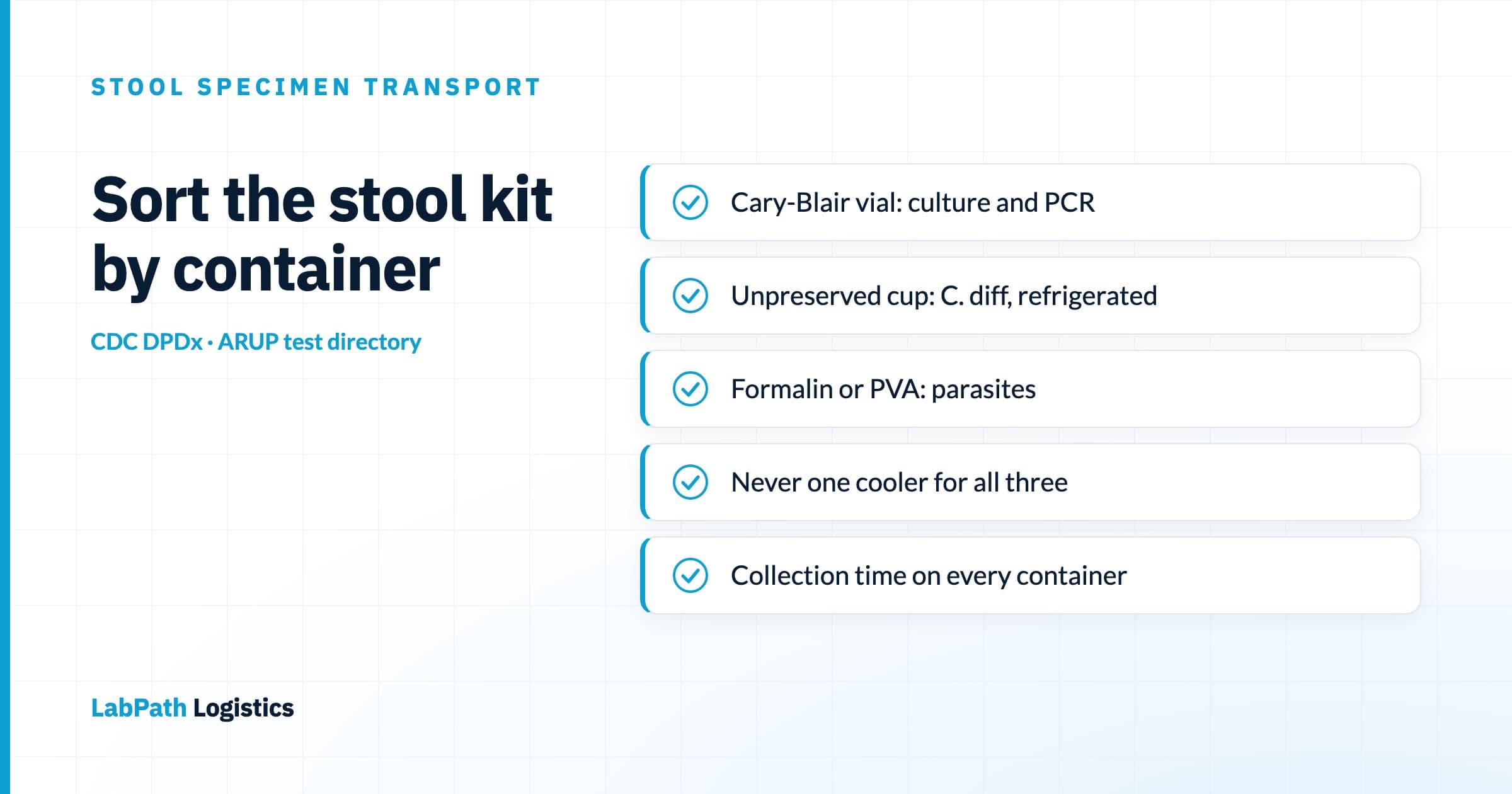
- Transport-media vial (Cary-Blair, often an orange or green cap, check your kit): for bacterial culture and many GI PCR panels. Follow the lab's listed temperature; ARUP's Campylobacter culture lists refrigerated transport and 72 hours stability once preserved.
- Clean, unpreserved cup or vial: commonly for C. difficile testing. The clock is short at room temperature, so refrigerate unless the lab says otherwise. Never pour it into a preservative "to be safe."
- Fixative vials (10% formalin and PVA or the lab's single-vial fixative): for ova and parasite exams. Preserved parasitology specimens are generally stable for a long time at room temperature; follow the lab's directory.
The Three-Container Stool Sort: save and send to your lab director
Tape this at the collection area. (1) Name the container: transport media, unpreserved, or fixative. (2) Write the collection date and time on every container, not just the bag. (3) Match the temperature to the receiving lab's listing for that test: refrigerated, room temperature, or either. (4) Write the deadline: collection time plus the lab's stability window, as a clock time. (5) If any unpreserved container's deadline lands before the next scheduled pickup, call for an earlier pickup or confirm the lab's rejection policy now, not after. Different containers in one patient bag can travel in different totes.
How Fast Must a Stool Sample for Parasites Reach the Lab?
Unpreserved, very fast. The CDC's parasitology reference, DPDx, says liquid stool should be examined within 30 minutes of passage, "not within 30 minutes of arrival in the laboratory," soft stool within one hour, and formed stool within a day with overnight refrigeration if needed. If delays cannot be avoided, it says the specimen should be preserved.
No courier can beat a 30-minute clock that starts at passage, which is why DPDx collection guidance recommends adding one volume of stool to three volumes of preservative. For an outpatient clinic or long-term care facility, the practical rule is simple: parasite specimens go into fixative at collection, and the courier's job is a clean, documented handoff, not a race.
A Houston Scenario: The Afternoon Diarrhea Workup
A long-term care facility north of the city has a resident with new diarrhea at 2 p.m. Staff collect a full workup: a Cary-Blair vial, an unpreserved cup for C. difficile, and an O&P fixative vial. Everything goes into one specimen bag on the nurse station counter for the 6 p.m. courier sweep. The culture and O&P are accepted. The C. difficile cup arrives four hours after collection at room temperature and is rejected.
Run the Three-Container Stool Sort and the fix costs nothing: the unpreserved cup goes into the specimen refrigerator with its collection time written on it, the other two follow the lab's listing, and the courier order names two handling classes instead of one. With hand hygiene and contact precautions already in play for suspected C. difficile, a clean sort also means fewer people re-handling the bag. Our nursing home lab courier guide covers sweep timing for facilities like this one.
The stakes are not abstract. The CDC estimates C. difficile caused about 223,900 infections in hospitalized patients and 12,800 deaths in the United States in 2017. A rejected specimen means a recollection, and a recollection means waiting on a result that the facility is waiting on to make decisions.
What Should You Require From a Courier for Stool Specimens?
- Handling classes on the order, per container: refrigerated, room temperature, or either. A single "stool" line invites one tote for everything. Our specimen transport temperature guide explains the ranges.
- Separate refrigerated and ambient compartments on the same run, so a mixed kit does not force a choice.
- A pickup timestamp and a receiver handoff timestamp for every package, so a rejection can be traced to collection, holding, or transit.
- A pickup time set against the shortest unpreserved deadline, not a loose afternoon window. See our pickup schedule guide and urgent care lab courier guide.
- No patient data. A courier needs a pickup point, destination, and handling class. Requisitions stay with the clinic and lab.
For the wider picture, see our guides to microbiology specimen transport, urine culture specimen transport, and the most common reasons specimens get rejected.
How Do You Price a Stool Pickup Lane?
Count your stool kits per day, list the shortest deadline in each kit, and note the lab's receiving cutoff. Then price a scheduled pickup timed to that deadline, with a same-day option for afternoon collections, in our nonbinding estimator. Our service levels page shows the public rate card. Estimates are not booking quotes.
LabPath Logistics is in early access for Greater Houston. Our booking-to-receiver-attestation workflow, including package QR scans, append-only custody events, and receiver signature, is verified locally; production dispatch, GPS, and temperature telemetry are not live yet. The booking model has no patient fields, by design. See our platform preview and privacy engineering notes for exactly what is verified.
Frequently Asked Questions
Should stool samples be refrigerated before transport?
It depends on the container and test. Unpreserved stool for C. difficile testing is commonly refrigerated, while some labs list refrigeration of unpreserved stool for bacterial culture as unacceptable. Stool in Cary-Blair or parasite fixative follows the lab's listing. Check the receiving lab's directory for each test.
How long is a stool sample good for in Cary-Blair?
Published windows vary by lab and test. ARUP lists 72 hours at room temperature or refrigerated for a Campylobacter culture specimen in Cary-Blair; other labs publish longer or shorter limits. Use the receiving lab's current figure.
Can a C. difficile stool specimen go in Cary-Blair media?
Often not. ARUP's toxigenic C. difficile test rejects stool preserved in Cary-Blair, formalin, or alcohol-based fixatives and requires a clean, unpreserved vial. Some culture-based methods differ, so confirm with the receiving lab.
Does a courier need patient information to transport stool specimens?
No. A courier needs a pickup point, a destination, a pickup time, and a handling class for each container, such as refrigerated or room temperature. Requisitions and patient identifiers stay with the clinic and the receiving lab.