White Bagging vs Buy-and-Bill: A Houston Logistics Test
October 20, 2026 · By LabPath Logistics Editorial Team, Medical Logistics Desk

Quick Answer
White bagging, buy-and-bill, and clear bagging differ in who controls the dose's last mile. Buy-and-bill keeps sourcing and custody with the clinic. White bagging hands both to a payer's specialty pharmacy and a parcel network. Clear bagging keeps them inside your own health system. Triage each payer lane with three logistics questions before committing.
Ask a Houston pharmacy director about white bagging vs buy-and-bill and you will usually hear a reimbursement argument: who buys the drug, who bills for it, and whose margin survives. That argument is real, but it hides the question your infusion nurses live with every morning — is the dose physically in the building, in date, at temperature, with a record of how it got there? Framed that way, the bagging decision is a logistics decision, and it deserves logistics scrutiny.
This guide gives you a short method we call the Three-Bag Triage: three questions you ask of every payer lane — white bag, clear bag, or buy-and-bill — before you accept a distribution model or build one. It takes minutes per payer and tells you where your real exposure sits.
What Do White Bagging, Clear Bagging, and Buy-and-Bill Actually Mean?
- Buy-and-bill: the clinic or hospital buys the drug from its wholesaler, stores it as regular inventory, administers it, and bills the payer. The clinic owns the dose and its handling from dock to chair.
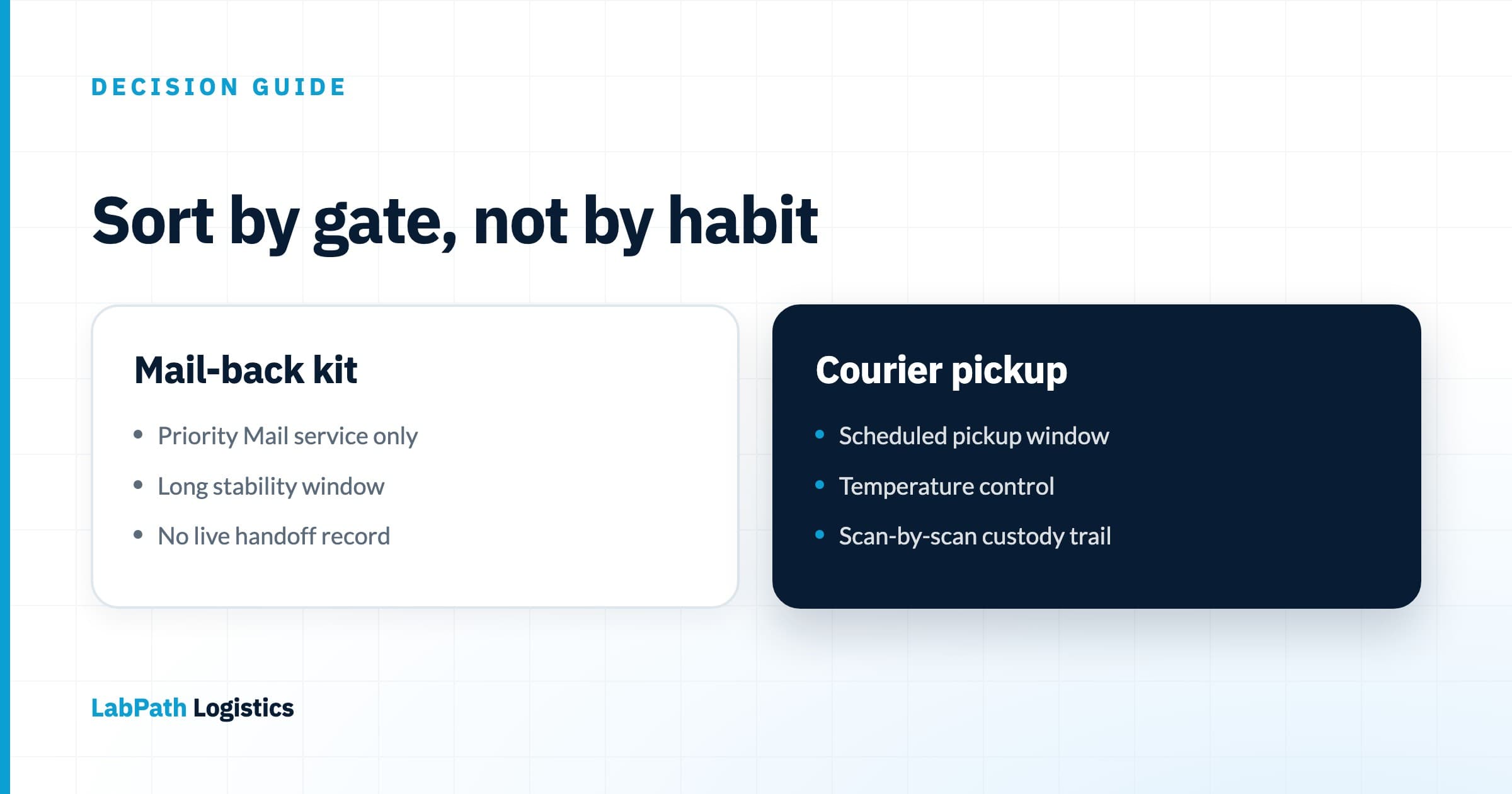
- White bagging: the payer requires the prescription to go through a specialty pharmacy — often payer-affiliated — which dispenses a patient-specific dose and ships it to the clinic, usually through a parcel network. The clinic administers a drug it never purchased.
- Brown bagging: the specialty pharmacy ships the dose to the patient, who carries it to the appointment. Most clinical bodies discourage it for infusions, and many facilities refuse it outright.
- Clear bagging: the health system's own specialty pharmacy dispenses the patient-specific dose and moves it internally to the infusion site. Ownership and custody stay inside the system — but someone still has to physically move the dose between sites.
The labels sound like billing trivia. Operationally, each one assigns the last mile to a different party: your wholesaler, a national parcel carrier, your patient, or your own inter-site transport. That assignment is what the triage below makes explicit.
Why Does the Last Mile Decide So Much?
92%
of surveyed hospitals reported problems with medications received through white or brown bagging, including doses arriving late and wrong drugs arriving (Vizient survey of ~260 hospitals, March–April 2021)
The same Vizient analysis estimated U.S. hospitals spend about $310 million a year managing white- and brown-bagging requirements — receiving, reconciling, chasing, and rescheduling. ASHP's current policy position calls for prohibiting payer-mandated distribution models that create patient-safety or supply-chain risk, precisely because a dose that arrives outside the pharmacy's own supply chain arrives without pedigree the pharmacy can verify.
None of that means white bagging never works. It means the model moves risk onto whoever receives the dose — and the receiving facility rarely prices that work when the mandate arrives.
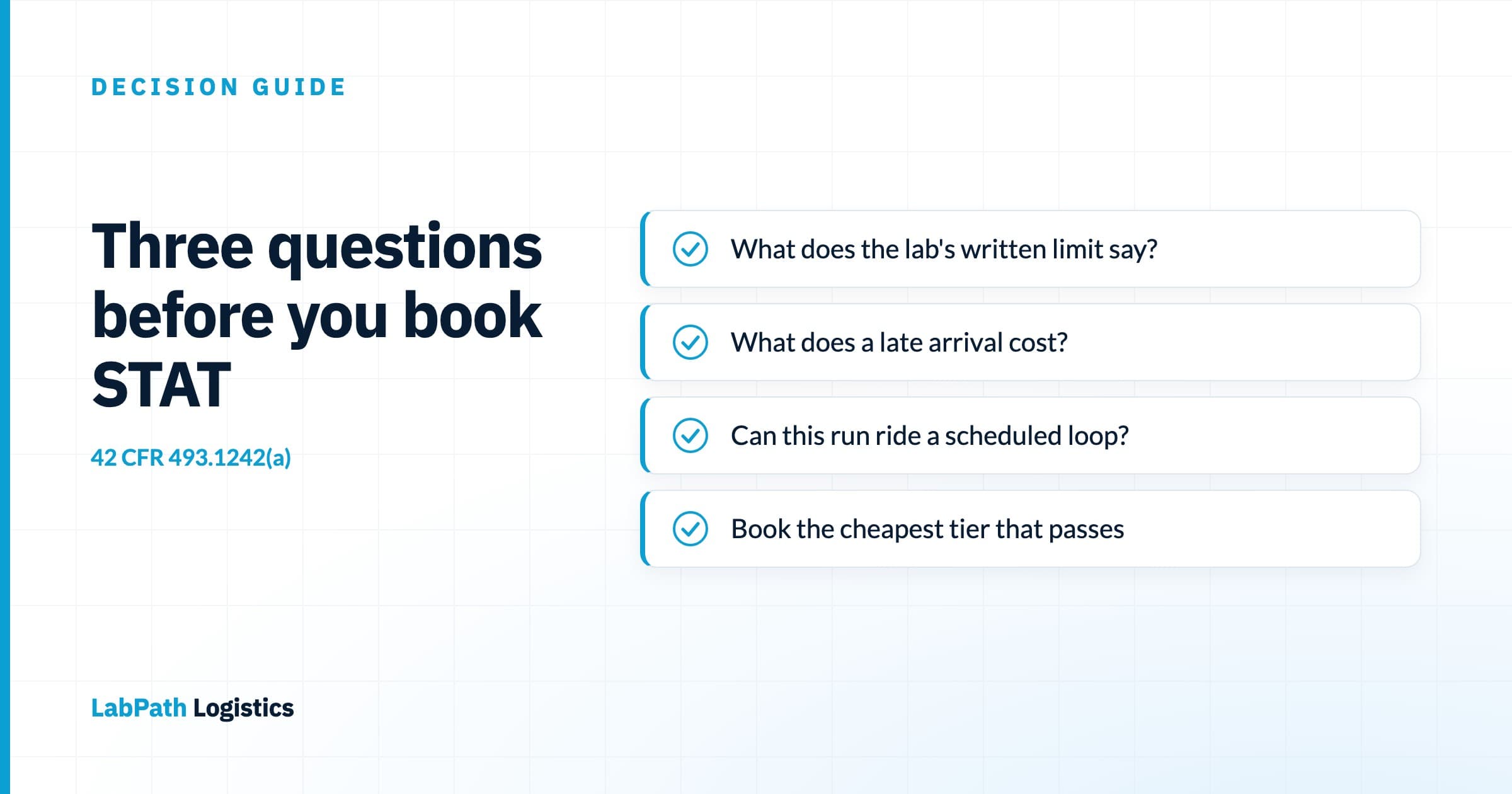
The Three-Bag Triage
- Who owns the dose at each handoff? Buy-and-bill: you, throughout. White bag: the payer's pharmacy until arrival, then an awkward middle where you store what you don't own. Clear bag: your system, throughout. Ownership decides who eats a wasted dose when a patient reschedules or a shipment cooks on a porch in a Houston August.
- Who moves it, on whose schedule? A wholesaler delivers to a predictable dock time. A parcel network delivers when the parcel network delivers. Clear bagging is only as good as the transport lane you build between your pharmacy and your infusion sites — if that lane is a staff member's car, you have rebuilt brown bagging with a badge.
- What record exists when it arrives? Buy-and-bill rides your wholesaler's pedigree. A white-bagged dose arrives with a tracking number, not a custody record — who held it, at what temperature, for how long. Clear bagging can produce the cleanest record of the three, but only if the inter-site leg is actually documented rather than assumed.
The Three-Bag Triage: save and send to your pharmacy director
For each payer lane, write three answers. (1) Ownership: who owns the dose at every handoff, and who absorbs a wasted dose? (2) Movement: who physically moves it, on whose schedule, and what happens on a missed delivery day? (3) Record: what custody and temperature evidence exists at arrival, and who produces it? Any lane where the honest answer is "nobody" or "a tracking number" is where your next rescheduled infusion comes from.
What Does Texas Law Say About White Bagging?
Texas House Bill 1647 (2023) prohibits state-regulated commercial insurers from requiring that clinician-administered drugs be dispensed only by certain pharmacies — including the payer's own specialty pharmacy — for patients with a chronic, complex, rare, or life-threatening condition, and bars shifting the cost difference to the patient. It applies to plans issued or renewed on or after January 1, 2024.
Two cautions before you treat that as the end of white bagging in Houston. First, state insurance law generally does not reach self-funded employer plans, which cover a large share of commercially insured Texans, so some mandates will persist. Second, the law restricts mandates; it does not prevent a facility from choosing white bagging or clear bagging where the economics or the pharmacy's reach make sense. The triage still has to be run — our guide to Texas pharmacy delivery rules covers the delivery-side regulations that apply once a dose is moving.
A Houston Scenario: The Dose That Missed the Chair
An infusion center in Sugar Land schedules a patient for a Thursday biologic. The payer requires white bagging, so the dose ships Monday from an out-of-state specialty pharmacy. Wednesday evening the tracking page still says "in transit." Thursday morning the nurse manager reschedules the patient, the chair sits empty, and when the box finally arrives Friday, the pharmacist quarantines it because nobody can say how long it sat on a truck at ambient temperature. The clinic did everything right and still owns the fallout.
Across town, a health system runs the same drug through its own specialty pharmacy near the Texas Medical Center and clear-bags patient-specific doses to its suburban infusion sites on a scheduled morning run — same courier, same window, every dispensing day, with each handoff recorded. Nothing about the drug changed. What changed is who owns the last mile, which is the point of running the triage before the payer runs it for you.
When Does Each Model Make Logistics Sense?
Buy-and-bill wins when your volume justifies carrying inventory and your wholesaler lane is reliable; the waste risk of patient-specific dosing stays with you, but so does control. White bagging, where a plan lawfully requires it or the drug is one you rarely administer, is manageable if you build receiving discipline around it: a named receiving owner, a quarantine shelf, and a reconciliation step before the patient is ever scheduled. Clear bagging gives a health system the custody story payers and accreditors like — but it quietly creates a recurring inter-site transport lane that someone must run with the same discipline as a compounded sterile preparation delivery: time-windowed, temperature-controlled, and documented at both ends.
That inter-site lane is where a dedicated medical courier belongs. The requirements look exactly like the ones in our infusion drug delivery guide: scheduled runs tied to dispensing times, chain-of-custody records at every handoff, and a plan for the day a dose must move between sites off-schedule — the same muscle hospitals use for drug shortage loans between pharmacies. If you are standing up a clear-bag lane for the first time, run it like a two-week courier pilot on one route before committing the whole network.
How Do You Price the Internal Lane?
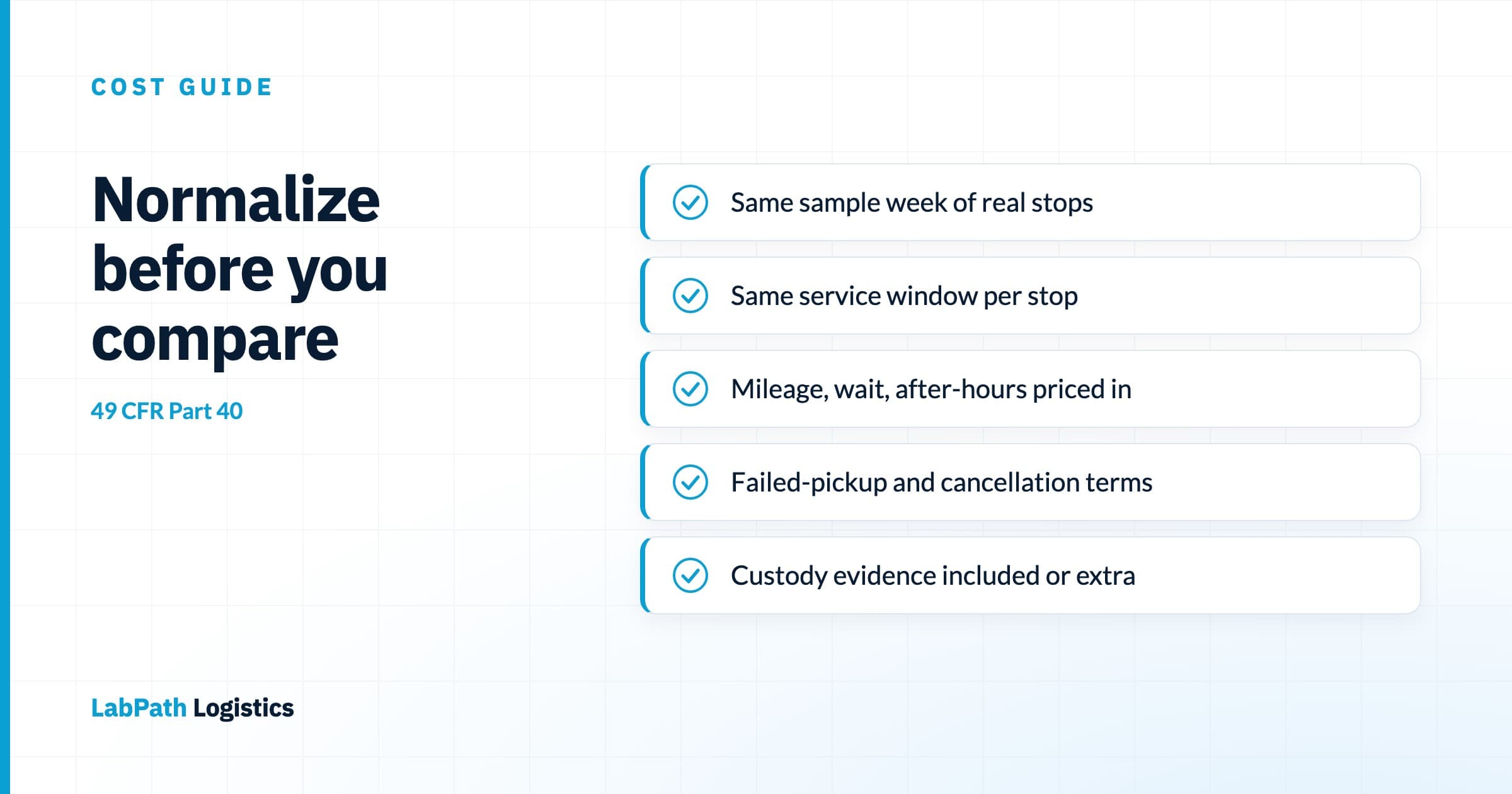
Price it like any other recurring route: pickup window at the pharmacy, delivery window at each infusion site, temperature handling, and what evidence you get per handoff. Our nonbinding estimator prices a Houston lane without signup, so you can put a real number next to the white-bag status quo — and our services page shows how scheduled shared stops differ from dedicated routes before you choose one.
LabPath Logistics is in early access for Greater Houston. Our booking-to-receiver-attestation workflow — package QR scans, append-only custody events, receiver attestation and signature — is verified locally; production dispatch, GPS, and temperature telemetry are not live yet, and the booking model has no patient fields, by design, which matters when the package is a patient-specific dose. See the platform preview and privacy engineering notes for exactly what is verified today.
Frequently Asked Questions
Is white bagging legal in Texas?
White bagging itself is legal, but Texas HB 1647 (effective for plans issued or renewed on or after January 1, 2024) prohibits state-regulated commercial insurers from mandating that clinician-administered drugs for patients with chronic, complex, rare, or life-threatening conditions be dispensed only by certain pharmacies. Self-funded employer plans are generally outside state insurance regulation, so some white-bag mandates remain in force.
What is the difference between white bagging and clear bagging?
In white bagging, an external specialty pharmacy — often payer-affiliated — dispenses a patient-specific dose and ships it to the clinic, usually by parcel carrier. In clear bagging, the health system's own specialty pharmacy dispenses the dose and moves it internally to the infusion site, keeping ownership, storage, and custody records inside the system. Clear bagging requires a reliable inter-site transport lane to work.
Why do hospitals and pharmacists object to white bagging?
Because the dose arrives outside the hospital's own supply chain. A 2021 Vizient survey of roughly 260 hospitals found 92 percent had experienced problems with white- or brown-bagged medications, including late arrivals and wrong drugs, and ASHP's policy position urges prohibiting payer-mandated distribution models that create patient-safety or supply-chain risks. The receiving facility also absorbs unreimbursed receiving, storage, and rescheduling work.
Who transports clear-bagged medications between a pharmacy and infusion sites?
Either the health system's own drivers or a contracted medical courier running scheduled routes between the dispensing pharmacy and each infusion site. Whichever you choose, the lane should have fixed pickup windows tied to dispensing times, temperature-appropriate handling, and a custody record at every handoff — the same standards you would demand for compounded sterile preparations.