Bone Marrow Specimen Transport in Houston: 3 Clocks
October 24, 2026 · By LabPath Logistics Editorial Team, Medical Logistics Desk
Quick Answer
Bone marrow aspirates for flow cytometry and chromosome analysis carry living cells, so they usually travel at room temperature, never frozen, inside a stability window often listed at 48 to 72 hours. Transport fails when the specimen arrives on a day the receiving lab does not accept it, so confirm the lab's receiving days before a late-week draw.
Bone marrow specimen transport rarely fails in the cooler. It fails on the calendar. A Houston oncology practice can draw a perfect aspirate, label it cleanly, keep it at room temperature, and still lose the result because the tube reaches a lab on a Saturday that lab does not receive. The patient cannot simply be redrawn tomorrow, so a marrow that misses its window costs far more than a routine tube.
This guide gives you the Three-Clock Marrow Check: a two-minute review that tells a clinic, before the procedure is booked, whether a late-week marrow can actually reach its lab in a usable state. It is logistics only. Test selection, tube choice, and clinical timing belong to the ordering physician and the receiving laboratory.
Why Is Bone Marrow Transport Different From Routine Blood?
Most send-out tubes carry analytes. A marrow aspirate sent for flow cytometry or chromosome analysis carries living cells that the lab must count, stain, or grow in culture. That changes the handling rules in three ways.
- Temperature: labs commonly want room temperature, and freezing is typically a rejection. Some labs accept refrigeration; some explicitly do not. The receiving lab's directory is the rule, not habit.
- Time: stability windows are measured in hours or a few days, not weeks, and they can differ by anticoagulant for the same test.
- Replaceability: a marrow is an invasive procedure. Losing one is not a redraw at the next visit; it is a repeat procedure, which is why our guide to lost specimens in transit treats marrow as an irreplaceable class.
48 hours
ambient and refrigerated stability for bone marrow chromosome analysis, room-temperature transport, frozen and clotted specimens unacceptable (ARUP Laboratories test directory, test 2002292)
That figure comes from ARUP's published requirements for bone marrow chromosome analysis, which call for a sodium heparin tube and say not to freeze or expose the specimen to extreme temperatures. Other labs publish different windows for different tests. Use the number your lab publishes for the test you are ordering.
The Three-Clock Marrow Check
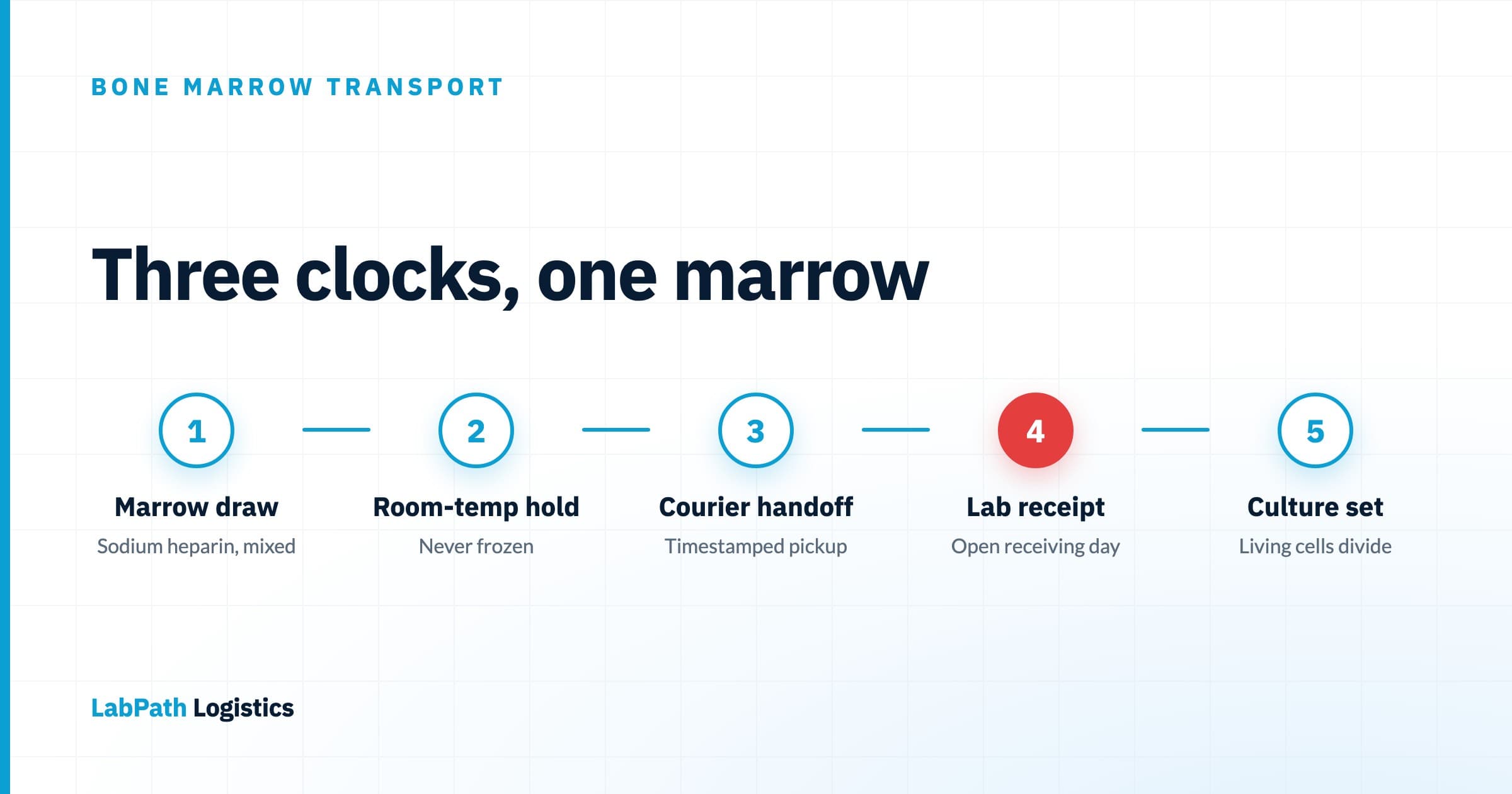
Every marrow runs on three clocks at once. The specimen is usable only where all three overlap.
- The stability clock. How many hours does the receiving lab allow for this test, in this tube, at the temperature you will ship? Write the deadline as a date and time, not a number of hours.
- The lab calendar clock. On which days and hours does that lab receive this test? A lab can be open for chemistry and closed for flow cytometry on the same Saturday.
- The transport clock. When will a courier pick up, and when will the tube be in the lab's hands? For a local lab that is a drive; for an out-of-state lab it is a drive plus a flight or overnight carrier, which our next-flight-out guide breaks down.
The Three-Clock Marrow Check: save and send to your lab director
Before booking any marrow on a Thursday afternoon or Friday, write three lines. (1) Stability deadline: date and time, from the lab's directory, for this test and tube. (2) Lab receiving window: the days and hours the lab accepts this test. (3) Arrival time: courier pickup plus transit. If arrival falls before the deadline AND inside the receiving window, book it. If not, move the draw, change the lab, or arrange the lab's documented weekend path in advance. Repeat for each test on the same marrow; flow and cytogenetics may go to different labs.
Do Labs Reject Bone Marrow Received on Weekends?
Some do, by written policy. The flow cytometry immunophenotyping listing in UTMB Health's lab test directory lists a specimen received on Saturday or Sunday as a rejection cause, with weekend emergencies sent to an outside reference lab only with the hematopathology director's approval. The same listing gives bone marrow in EDTA up to 48 hours and in sodium heparin up to 72 hours, at room temperature or refrigerated.
That is not a criticism of any lab; it is how specialized benches are staffed. The point for a clinic is that a 72-hour window does not mean a Friday 3 p.m. draw is safe. If the lab will not receive it until Monday, the usable time is whatever is left after the weekend, and the rejection reason on paper may be the receiving day, not the stability limit.
A Houston Scenario: The Friday Afternoon Marrow
A community hematology practice southwest of the city books marrow biopsies on Friday afternoons because that is when its procedure room is free. Each aspirate is split: flow cytometry to a regional hospital lab, chromosome analysis to a national reference lab. The 1 p.m. procedures are fine. The 3:30 p.m. procedures keep coming back with problems, and staff assume it is bad luck.
Run the Three-Clock Marrow Check and the pattern is plain. The regional lab's flow bench does not receive on Saturday, and a late-afternoon courier run across Houston traffic lands after its Friday receiving cutoff. The reference lab receives every day, but only if the tube makes that evening's shipping tender. The fix is not a faster car. It is moving marrow procedures to earlier in the week or earlier in the day, and booking a scheduled room-temperature pickup timed to the regional lab's cutoff, with our guide to setting pickup schedules for the sweep times.
What Should a Clinic Require From Its Courier for Marrow?
Under CLIA, a laboratory must have written procedures that cover specimen transportation and must record the date and time it receives each specimen (42 CFR 493.1242). A courier that cannot show when it picked up and when it handed off leaves a gap right where a marrow dispute starts.
- A room-temperature handling instruction on the order, so a driver never drops a marrow into a refrigerated tote by default.
- A pickup timestamp and a receiver handoff timestamp for every package, retrievable later.
- A pickup time set against the lab's receiving cutoff, not a loose window. Our shared vs dedicated route guide explains when a stop needs a fixed minute.
- A stated plan for a late-day marrow: who decides, before the procedure, whether the specimen goes to a weekend-receiving lab or the draw moves.
- Requisitions and labels handled by the clinic and lab, not the courier. The courier needs a pickup point, a destination, and a handling class, nothing about the patient.
For the broader send-out picture, see our guides to send-out testing logistics and surgical pathology specimen transport, which covers fresh tissue for lymphoma workups.
How Do You Price a Marrow Lane?
List your marrow days, the labs for each test, and each lab's receiving cutoff. Then price a scheduled pickup timed to the earliest cutoff in our nonbinding estimator. Our service levels page shows the scheduled, same-day, and STAT options on the public card. Estimates are not booking quotes.
LabPath Logistics is in early access for Greater Houston. Our booking-to-receiver-attestation workflow, including package QR scans, append-only custody events, and receiver signature, is verified locally; production dispatch, GPS, and temperature telemetry are not live yet. The booking model has no patient fields, by design. See our platform preview and privacy engineering notes for exactly what is verified.
Frequently Asked Questions
What temperature should a bone marrow specimen be transported at?
Most labs ask for room temperature, roughly 18 to 22 °C, for bone marrow sent for flow cytometry or chromosome analysis, and frozen specimens are typically rejected. Some labs also accept refrigeration and some do not, so follow the receiving lab's published requirements for the specific test.
How long is a bone marrow aspirate stable for transport?
It depends on the test, tube, and lab. ARUP lists 48 hours ambient or refrigerated for bone marrow chromosome analysis. UTMB Health's flow cytometry listing gives 48 hours in EDTA and 72 hours in sodium heparin. Always use the receiving lab's current figure.
Can I send a bone marrow specimen on a Friday?
Only if the arrival lands inside both the stability window and the lab's receiving days. Some labs reject flow cytometry specimens received on Saturday or Sunday. Confirm the lab's receiving schedule and your courier's arrival time before booking a late-week procedure.
Does a courier need patient information to transport a bone marrow specimen?
No. A courier needs a pickup point, a destination, a pickup time, and a handling class such as room temperature, do not freeze. Requisitions and patient identifiers stay with the clinic and the receiving lab.