Shared vs Dedicated Medical Courier Routes in Houston
October 23, 2026 · By LabPath Logistics Editorial Team, Medical Logistics Desk
Quick Answer
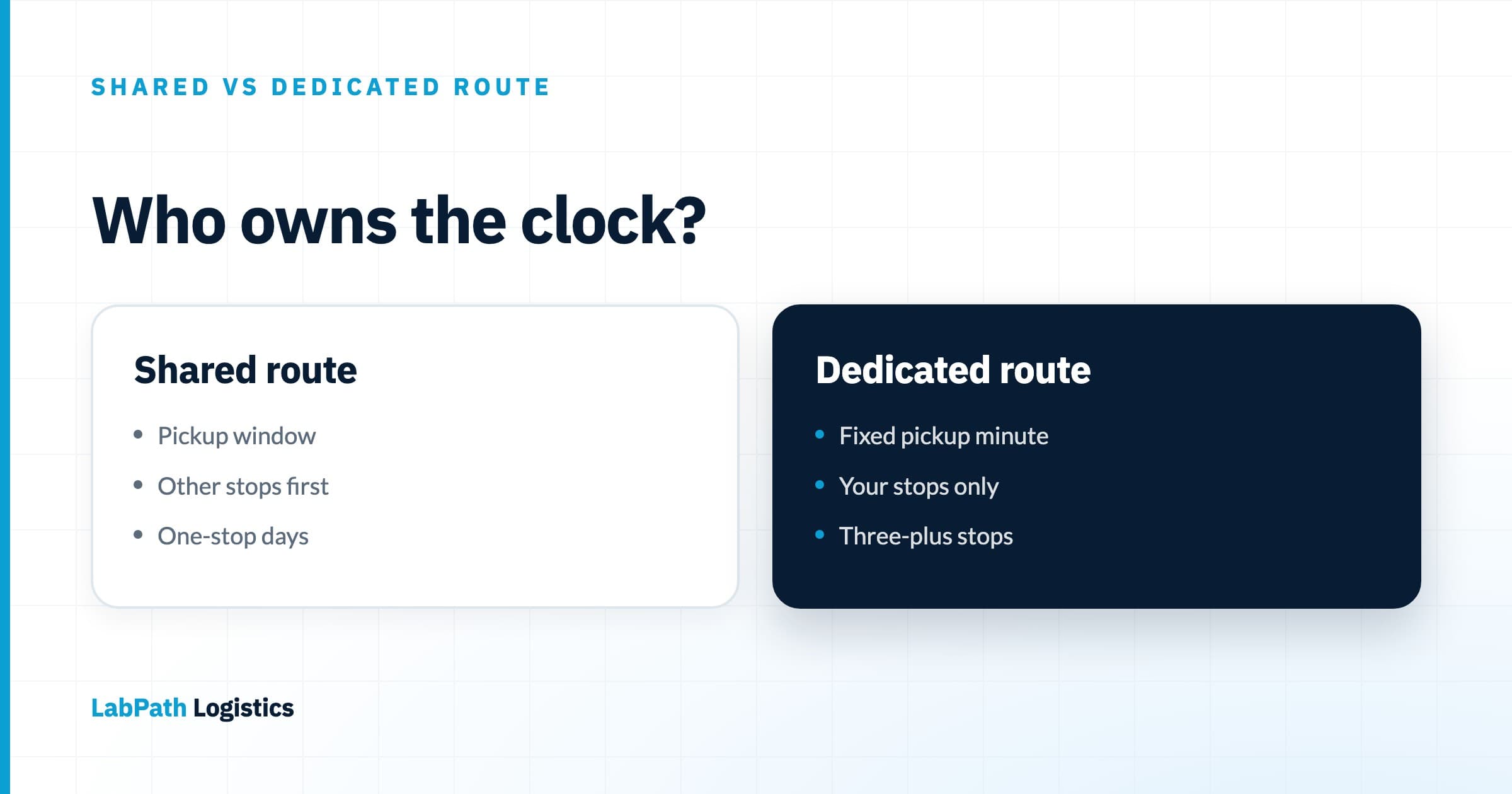
A shared courier route puts your stop on a loop with other facilities, so you buy a pickup window. A dedicated route reserves the vehicle for your stops, so you buy control of the clock. Choose dedicated when a specimen has a hard time limit, you need a fixed pickup minute, or you run three or more stops a day.
Most Houston facilities shopping for scheduled specimen pickups ask the wrong first question about a shared vs dedicated courier route: which one is cheaper? On our own public rate card, at three stops a day, the answer is neither. Three shared stops and a dedicated route both start at $114 a day. If price per stop does not separate them, something else has to, and that something is the reason your courier choice either holds up or falls apart on a bad Tuesday.
This guide gives you the Clock-Owner Test: four questions that tell you, stop by stop, whether you need a pickup window or a pickup minute. It takes about ten minutes with your current pickup log, and it works whether you end up with us or another courier.
What Is the Difference Between a Shared and a Dedicated Courier Route?
A shared route is a loop the courier runs for several facilities; your stop is one of many, and you are promised a window. A dedicated route is a vehicle and driver reserved for your stops on your schedule; you are promised a time. In both cases a driver arrives on a recurring cadence, so both are scheduled service, not on-demand. The difference is whose stops come before yours and who absorbs the delay when one of them runs long.
- Shared: you buy a pickup window. Cost scales stop by stop, and a single daily stop is economical.
- Dedicated: you buy control of the clock. You pay a route minimum, and the route answers only to your stop order.
- Neither: if your need is unpredictable or truly urgent, a scheduled route of either kind is the wrong tool, and on-demand or STAT service is the comparison to make.
$114 = $114
three shared stops ($38 each) vs. a dedicated route minimum covering three stops, on LabPath's nonbinding public rate card; mileage rules differ, and a booking quote is set by the backend at booking
Those are our public estimate figures, not a booking quote, and mileage is counted differently: a shared stop includes its first 10 incremental miles, while a dedicated route includes its first 10 total route miles, then $1.50 a mile. Check any courier's card for the same split. The point is the structure: when the stop price matches, you are choosing a service model, not a discount.
The Clock-Owner Test: Four Questions
- Does any specimen at this stop have a hard time limit? If the receiving lab's stability or processing requirement means a 30-minute slip changes the result or forces a recollection, the stop needs a minute, not a window.
- Is the pickup time fixed by something you do not control? A centrifuge cycle, a surgery block, a send-out cutoff, or a next-flight-out tender time all set the clock for you. Fixed upstream times favor dedicated.
- How many stops do you run a day on this lane? One stop a day rarely justifies a route minimum. Three or more stops, especially between your own sites, is where a dedicated route stops costing more on paper.
- What happens when someone else's stop runs long? If a 20-minute delay upstream costs you nothing, shared is fine. If it costs you a missed cutoff, you are paying for that delay already, just not on the invoice.
The Clock-Owner Test: save and send to your lab director
For each pickup on your log, answer four questions. (1) Hard time limit on any specimen? (2) Pickup time fixed upstream? (3) Three or more stops a day on this lane? (4) Does an upstream delay cost you a cutoff? Two or more yeses: price a dedicated route. Zero or one yes: a shared stop is likely the better buy. Score each stop separately; most facilities end up with a mix.
Why Does Houston Traffic Make This Decision Sharper?
A shared loop stacks delay. Every facility before yours is a chance for a parking hunt, a lobby wait, or a cooler that is not ready, and in Houston each leg between those stops crosses some of the most congested pavement in the state. A window that looks generous at 9 a.m. can compress to nothing by the late-afternoon sweep.
No. 1
the West Loop (I-610) between I-10 and US 59 ranked the most congested road segment in Texas for the third year running; the Houston area holds 36 of the state's 100 most congested segments (Texas A&M Transportation Institute and TxDOT, 2025)
The Texas A&M Transportation Institute's 2025 ranking is a planning input, not a prediction for any given day. What it tells a route buyer is that variance is the normal case here, and the question is who absorbs it. On a shared loop, you share it with everyone ahead of you. On a dedicated route, only your own stops can make you late.
A Houston Scenario: Three Clinics Around the Galleria
A multi-site primary care group runs three clinics on the inner west side, with draws at each site and a reference lab across the West Loop. Today each clinic books its own shared stop. The morning stops are fine. The 3:30 p.m. pickups land anywhere from on time to 50 minutes late, and the late ones miss the lab's same-day processing cutoff.
Run the Clock-Owner Test and the morning stops score zero or one yes: shared works. The afternoon stops score three: a hard processing cutoff, a fixed lab tender time, and three stops on one lane. The group does not need a dedicated route all day. It needs one afternoon dedicated sweep through its own three sites, and shared stops in the morning. That mixed design is common, and our guide to sizing pickup schedules shows how to set the sweep times.
What Should You Require From Either Route?
Whatever model you choose, the paperwork obligation stays with the lab. Under CLIA, a laboratory must have written procedures covering the conditions for specimen transportation and must document the date and time it receives each specimen (42 CFR 493.1242). A route that cannot tell you when it picked up and when it handed off makes both of those harder to prove.
- A written window or time per stop, in the agreement, not in an email thread.
- A pickup and handoff timestamp for every stop, retrievable later.
- A stated rule for what happens when the driver is late: who is told, and how fast.
- A backup driver plan for dedicated routes, because reserved capacity is only as good as its cover. Our backup plan guide lists what to ask.
- Accessorial terms for waits and add-on stops, which our invoice audit guide walks through line by line.
If you are still choosing between a scheduled route and on-call service at all, start with scheduled vs on-demand routes. If you have the model settled and want to test a courier before signing, our 14-day pilot guide shows how to trial one lane, and the staff driver break-even helps if the alternative is your own employee.
How Do You Price Your Own Route?
List your stops, mark each with its Clock-Owner score, and price the two groups separately. Our nonbinding estimator prices scheduled stops and dedicated routes without signup, so you can compare a mixed design against what you pay now before you talk to anyone.
LabPath Logistics is in early access for Greater Houston. Our booking-to-receiver-attestation workflow, including package QR scans, append-only custody events, and receiver signature, is verified locally; production dispatch, GPS, and temperature telemetry are not live yet, and the booking model has no patient fields, by design. See our platform preview and privacy engineering notes for exactly what is verified. Estimates from our public card are not booking quotes.
Frequently Asked Questions
What is a dedicated courier route?
A dedicated courier route is a vehicle and driver reserved for one facility or group's stops on a recurring schedule. Because no other customer's stops are on the loop, pickups happen at set times rather than within a window. It usually carries a daily route minimum, which makes it most economical at three or more stops a day.
Is a shared courier route cheaper than a dedicated route?
Per stop, not always. On LabPath's nonbinding public card, three shared stops and a dedicated route minimum both come to $114 a day, with different mileage rules. A shared stop is clearly cheaper when you need only one or two pickups a day. Above that, compare the service model, not just the stop price.
When should a lab choose a dedicated route over shared pickups?
When a specimen has a hard time limit, when the pickup time is fixed by something upstream such as a processing cutoff or flight tender, when you run three or more stops a day on one lane, or when an upstream delay would cost you a cutoff. Two or more of those usually justify pricing a dedicated route.
Can I mix shared stops and a dedicated route?
Yes, and many multi-site facilities should. A common design uses shared stops for low-urgency morning pickups and one dedicated sweep for the time-critical afternoon run. Score each pickup separately and price the two groups on their own rather than buying one model for the whole day.