CSF Specimen Transport in Houston: The 60-Minute Rule
October 27, 2026 · By LabPath Logistics Editorial Team, Medical Logistics Desk
Quick Answer
Cerebrospinal fluid (CSF) should reach the lab fast and, for culture, never on ice. One university lab guide asks for delivery within 1 hour at room temperature and says never to refrigerate CSF. A 2018 study found manual cell counts should be done within 60 minutes. Treat CSF as a dedicated run, not a scheduled-stop specimen.
Most courier habits are built for blood and urine: label it, bag it, put it in the cooler, hand it off at the next scheduled stop. CSF specimen transport in Houston breaks two of those habits at once. The cooler can be the wrong place for it, and the next scheduled stop can be the wrong time.
Cerebrospinal fluid comes from a lumbar puncture, a procedure that cannot be repeated casually, and the volume is small. This guide gives you the CSF Handoff Card, three lines that settle temperature, tube order, and the lab's clock before the needle goes in. It covers logistics only. Which tests to order, and how to collect, belong to your clinicians and the receiving laboratory.
How Fast and How Cold Does CSF Need to Travel?
Fast, and for culture, not cold. The University of Washington's laboratory test guide for CSF culture says to transport to the laboratory within 1 hour of collection at room temperature, and to never refrigerate CSF because Neisseria meningitidis is susceptible to cold. The same guide rejects specimens received more than 24 hours after collection, but that is the outer limit, not the target.
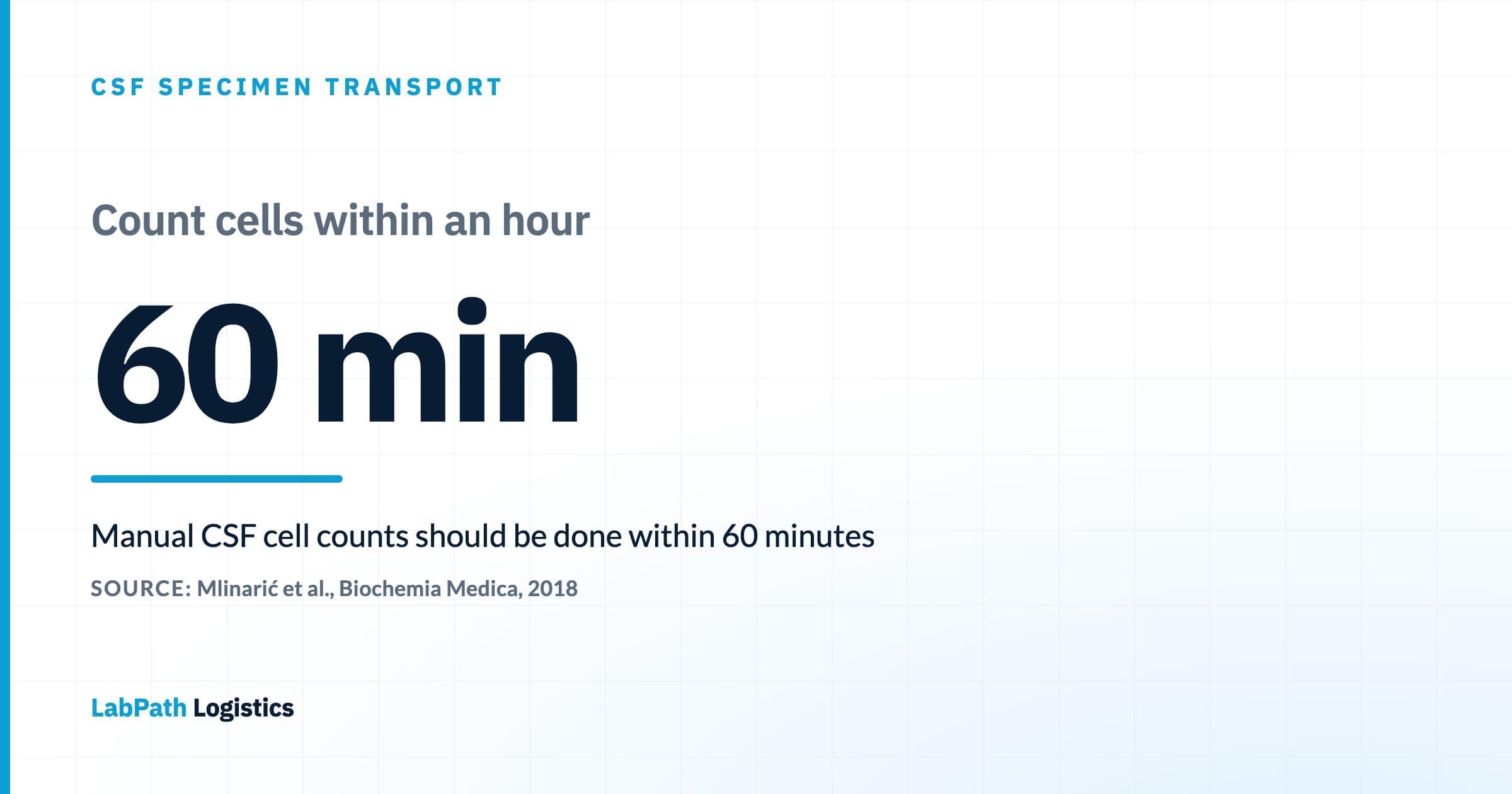
Cell counts have their own clock. In a study of 32 CSF samples from extraventricular drainage systems, Mlinarić and colleagues reported that total cells, neutrophils, and phagocytes fell with delay, and concluded that manual cell counting should be performed within 60 minutes because any delay can alter results.
60 minutes
the window the authors recommend for manual CSF cell counting; counts changed as delay grew (Mlinarić A, Vogrinc Ž, Drenšek Z. Biochemia Medica, 2018, 32 drainage samples)
Labs differ. Some accept CSF for culture for longer, some set shorter limits. Your receiving lab's current test directory is the rule that counts, and it should be written on the handoff card.
What Is the CSF Handoff Card?
The CSF Handoff Card: save and send to your procedure lead
(1) Which tube, for which lab: the tubes are numbered in collection order, and the lab's directory says which tube goes to which section, so the label must carry the tube number the lab expects. (2) What temperature: room temperature for culture, never on ice or in the refrigerator unless the lab's directory says otherwise for that test. Confirm each test on the order, because a mixed order can have mixed rules. (3) The lab's clock: write the collection time on the label and the receiving lab's limit next to it, then count back to the latest pickup time. If the card is not complete when the tubes are drawn, the courier is guessing.
Why Is a Standard Specimen Cooler the Wrong Default?
Many couriers and clinic staff treat the cooler as a universal safe place. For CSF culture that instinct can hurt the result, since the guidance above is to keep it at room temperature. This is the same lesson as our specimen transport temperature guide: the handling class comes from the test, not from habit. Our microbiology specimen guide covers the wider set of culture rules.
Packaging still matters. Diagnostic specimens shipped as UN3373 Category B use the triple packaging in 49 CFR 173.199. Room-temperature does not mean unpackaged. See our Category B packaging guide.
A Houston Scenario: The Procedure Room Two Miles From the Lab
A freestanding emergency clinic in the Heights performs a lumbar puncture at 2:40 p.m. The tubes are labeled, bagged, and put in the specimen cooler next to the blood tubes, ready for the 4 p.m. scheduled pickup. At 4 p.m. the pickup arrives, and the reference lab is across Loop 610 in rush-hour traffic. By the time the specimen is received, it has been out well past an hour, and part of it sat on ice.
With a CSF Handoff Card, line two flags the ice, and line three sets a pickup limit of minutes, not a scheduled window. The decision is no longer "the 4 p.m. stop" but "a dedicated run, leaving as the procedure ends." For other STAT specimens, our freestanding ER lab courier guide and STAT blood delivery piece cover the same routing question.
Scheduled Stop, Shared Route, or Dedicated Run?
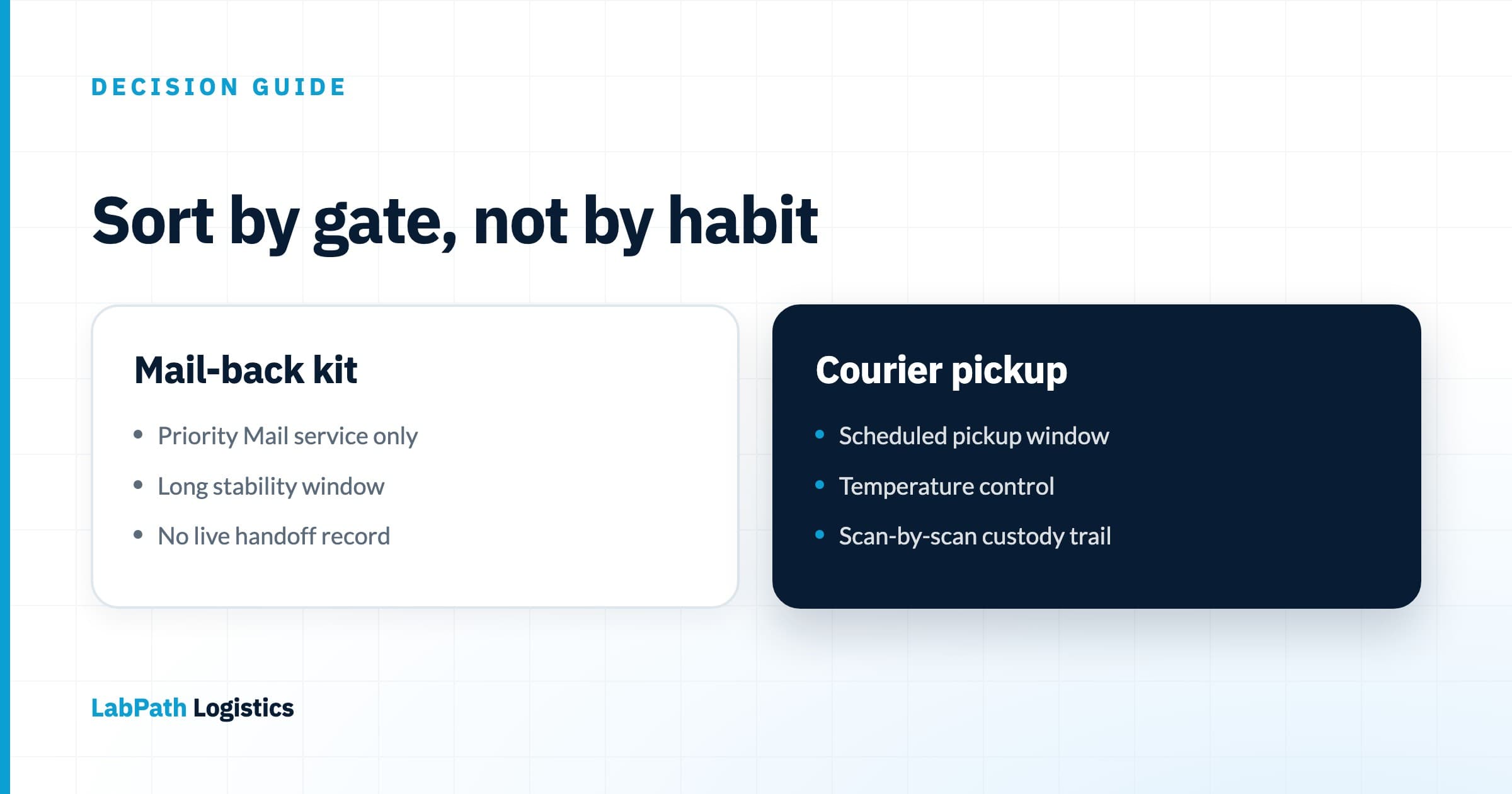
- Scheduled stop: fits specimens with a long stability window. It rarely fits CSF, because the next stop is set by the route, not by the specimen.
- Shared route: can work if the stop is timed to the procedure and the lab's limit leaves room for the whole route. Ask for the actual stop order, not the average.
- Dedicated run: fits CSF when the lab's limit is short or the route is long. The courier leaves for the lab when the tubes are ready and does not make other stops. Our shared vs. dedicated route guide compares the tradeoffs.
Price the dedicated option before you need it. The public rate card on our services page lists STAT from $95, with mileage and handling adjustments, and the nonbinding estimator prices your actual lane. Estimates are not booking quotes. A courier backup plan should name who moves a CSF specimen if the courier cannot.
LabPath Logistics is in early access for Greater Houston. Our booking-to-receiver-attestation workflow, including package QR scans, append-only custody events, and receiver signature, is verified locally; production dispatch, GPS, and temperature telemetry are not live yet. The booking model has no patient fields, by design. See our platform preview and privacy engineering notes for exactly what is verified.
Frequently Asked Questions
Should CSF be transported on ice?
For bacterial culture, generally no. The University of Washington's CSF culture guide says to transport at room temperature and never refrigerate CSF. Some other tests have different handling, so confirm each test in the receiving lab's directory before the specimen leaves.
How long can CSF wait before it reaches the lab?
It depends on the test and the lab. One university lab asks for delivery within 1 hour at room temperature and rejects specimens older than 24 hours. A 2018 study recommends manual cell counts within 60 minutes. Use the limit in your own lab's test directory.
Can a scheduled courier pickup carry a CSF specimen?
Only if the pickup time fits inside the lab's limit with room for the drive. Because the clock starts at collection, most procedure sites find that a dedicated run, leaving when the tubes are ready, is the safer lane for CSF.
Does the courier need patient information for a CSF pickup?
No. A courier needs a pickup address, a destination, a ready time, and a handling class such as room temperature. Requisitions and patient identifiers stay with the clinic and the receiving lab.