Medical Courier Backup Plan for Houston Labs
October 12, 2026 · By LabPath Logistics Editorial Team, Medical Logistics Desk
Quick Answer
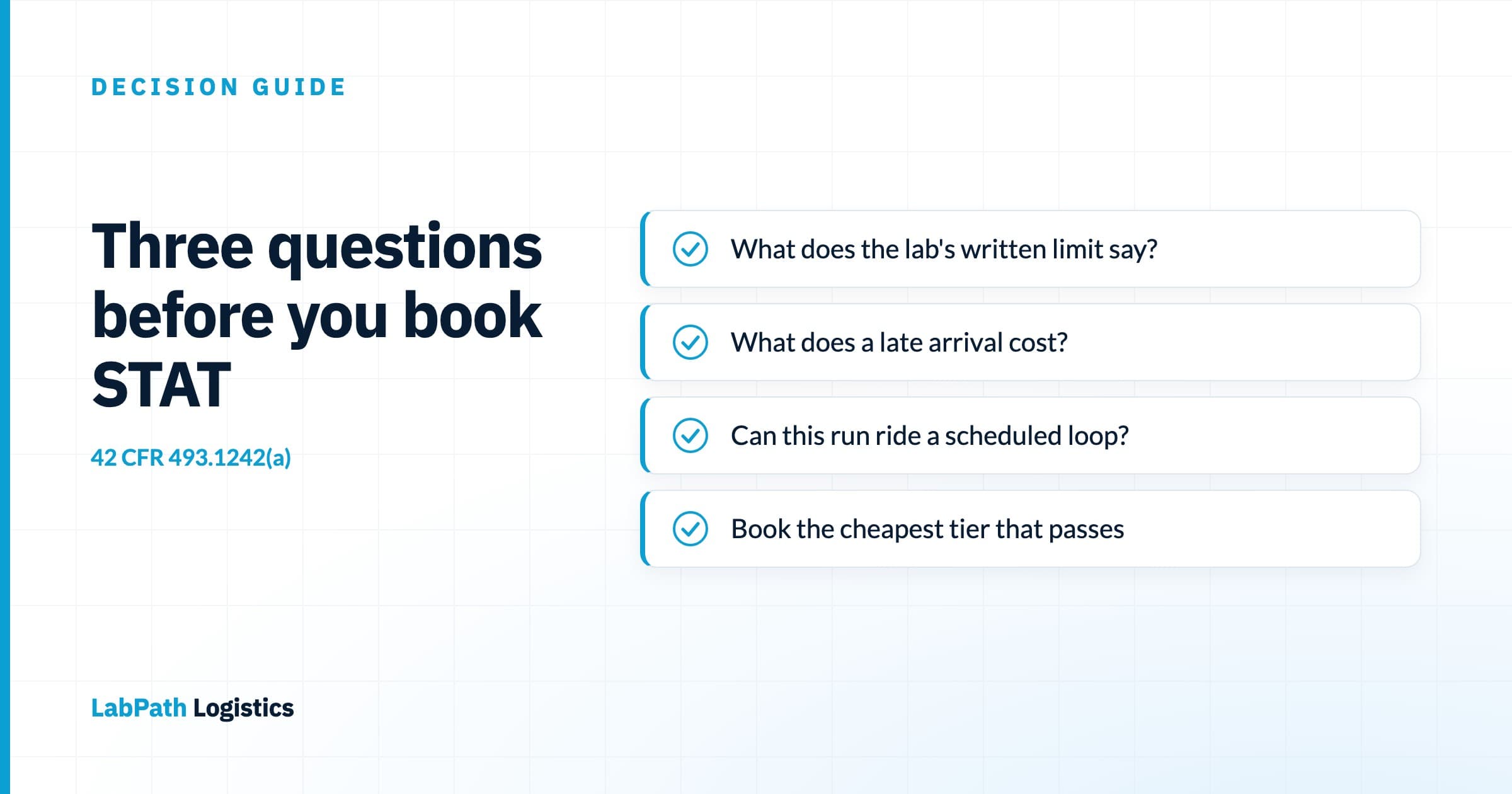
A medical courier backup plan is a written answer to one question: if the scheduled pickup does not happen, who moves the specimen, by when, and who decides? It needs a delay trigger tied to the test's stability limit, a named second option, and a custody record. Write it before the first missed pickup, not during it.
Every Houston lab has a courier backup plan. For most of them it is a person: the supervisor who notices at 4:40 p.m. that the driver has not come and starts calling around. That is not a plan, it is a favor the lab is asking of its own staff. A real medical courier backup plan lives on one page, names who acts at what time, and is something you can show a courier, an auditor, or a new hire.
This guide is for lab managers, clinic administrators, and outreach coordinators who are evaluating or renewing a courier and want a straight answer to "what happens when they don't show?" It gives you the 5-Line Backup Card, a template you can copy, and the questions that tell you whether a courier's own contingency plan is real.
What Is a Medical Courier Backup Plan?
It is the written procedure for a missed, late, or cancelled pickup. It sits between two things you already have: your specimen stability requirements, which set the deadline, and your courier agreement, which sets who is responsible. The plan connects them with a trigger, an alternative, and an owner.
Federal lab rules already expect part of this. Under 42 CFR 493.1242, a CLIA-certified laboratory must establish and follow written policies and procedures for "conditions for specimen transportation," as well as specimen storage and preservation, specimen acceptability and rejection, and specimen referral. A written rule for what happens when transport fails belongs in that same family of documents. Our chain of custody guide covers the record that backs it up.
How Often Do Courier Failures Actually Hit Labs?
Often enough that workarounds are routine. A 2023 survey of 269 lab professionals was conducted by CAP TODAY on behalf of medical courier company MedSpeed, so it comes from a vendor, and its own figures are not perfectly consistent. Read it as a signal, not a benchmark. In that survey, 42% of respondents said they had requested STAT pickups or deliveries to supplement unreliable scheduled service, 32% said they had transported or shipped specimens themselves, and 48% said they had stayed late waiting for a courier. The source is MedSpeed's published summary.
42%
of surveyed lab professionals said they had requested STAT pickups or deliveries to supplement unreliable scheduled service (CAP TODAY survey of 269 lab professionals, 2023, commissioned by courier company MedSpeed)
The useful takeaway is not the exact percentage. It is that unplanned backups already exist in most labs, they are improvised, and they cost staff time. A plan turns the improvisation into a procedure.
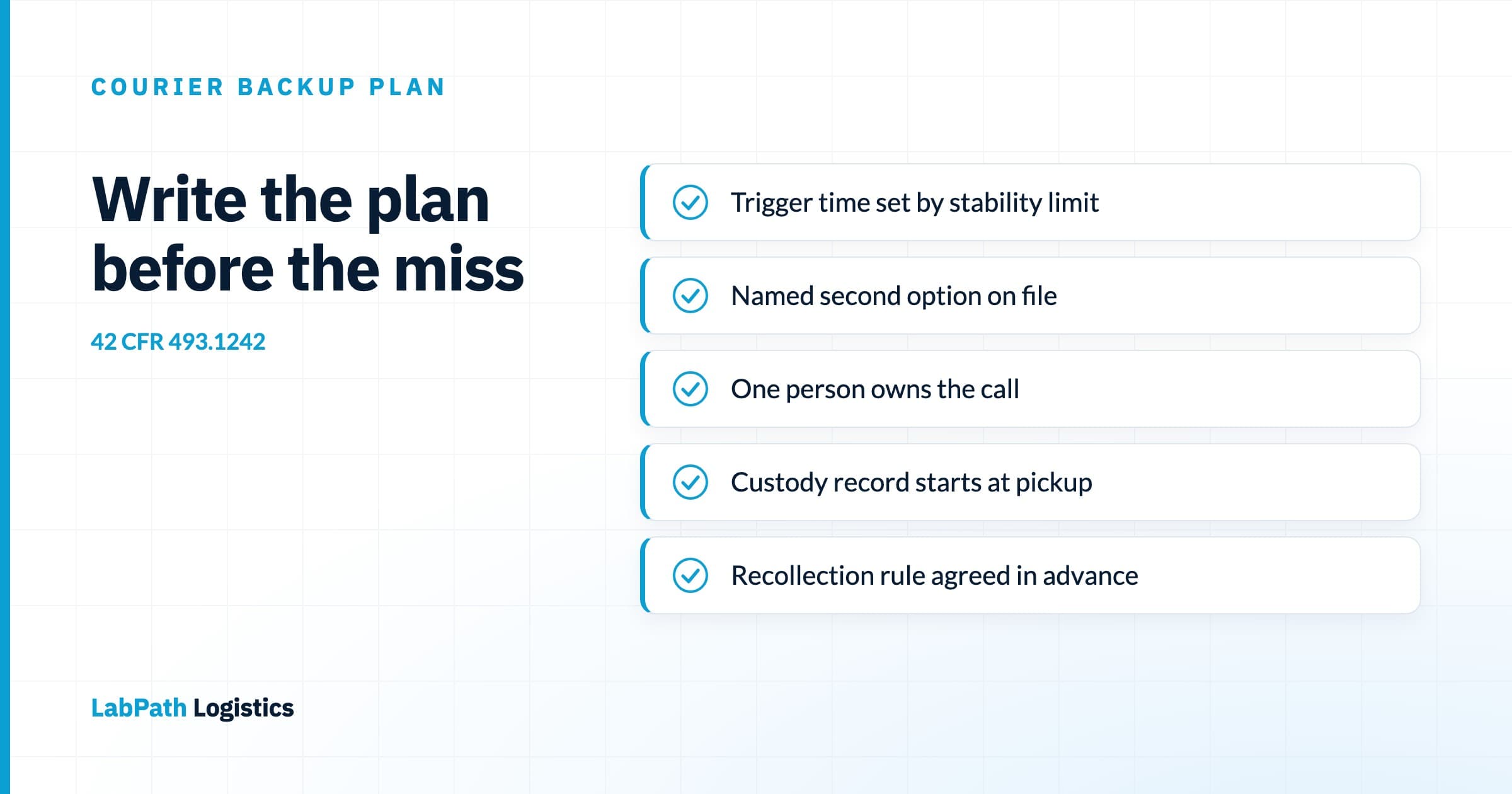
The 5-Line Backup Card: save and send to your lab director
Print one card per pickup lane and post it where the call gets made. Line 1, Trigger: the clock time at which a missing pickup becomes a backup event, set from the shortest stability limit on that lane, not from the courier's window. Line 2, Second option: a named backup (an on-demand STAT provider, a second contracted courier, or a staff run with safe-handling rules) with a phone number that someone has tested. Line 3, Owner: one person authorized to call the backup and spend the money, plus a named deputy for after hours. Line 4, Custody: the record starts when the box leaves the bench or lockbox, and the backup driver signs the same log. Line 5, Recollection: who contacts the ordering provider, and at what point a specimen is declared outside its window instead of sent anyway.
How Do You Set the Trigger Time?
Work backward from the shortest stability limit on the lane, not forward from the courier's pickup window. If the lane carries any time-sensitive tests, the trigger is early. Our guides on glucose and coagulation specimens show how short those limits can run, and your lab's own procedures set the real number. Then subtract the time the backup needs to arrive, and the time to get to the receiving lab. What is left is when you call.
Do not treat the end of the courier's pickup window as the trigger. By then the backup has less time than the specimen has left. A good rule is to add a mid-window check: if the driver has not arrived or messaged by the halfway point, someone checks in. Our pickup schedule guide explains how to build windows that make this check meaningful.
A Houston Scenario: The 4:40 p.m. No-Show
A multi-site clinic group in the Houston area has a scheduled pickup window that closes at 5:00 p.m. A heavy storm slows traffic on the Katy and Southwest corridors. By 4:40 the driver has not arrived and nobody has called. The lab's last collections include time-sensitive tests, and the on-call supervisor is at another site.
Without a card, the first twenty minutes go to finding a phone number and deciding who can authorize a rush charge. With a card, the 4:15 check was missed, the owner is named, the STAT provider's number is on the page, and the lab makes the call at the trigger time. The specimens move at 4:50 instead of 5:20. The difference is not a better courier. It is that the decision was made in advance. Our winter storm guide covers weather disruptions in more depth, and our after-hours guide covers coverage when the building is empty.
How Do You Judge a Courier's Own Contingency Plan?
A courier's contingency plan is part of what you are buying. Ask for it in writing, the same way you would ask for proof of training or insurance. Our RFP checklist and SLA guide list the other documents to request. For the backup plan specifically, ask these five questions:
- If a driver cannot make a scheduled stop, how soon do you tell us, and by what channel?
- Who covers a driver absence on our lane, and have they run it before?
- Do you hold on-call capacity for the hours we need, or do you dispatch on a best-effort basis?
- What happens to the specimens if a vehicle breaks down mid-route, and who is notified?
- How do we see a missed stop in your records, and is a missed pickup counted against your service level?
Listen for specifics. "We always have someone" is a promise. "A named relief driver covers that route and is notified at 3:30" is a procedure. If a courier cannot describe the second one, the backup lives on your side of the line. Our switching guide covers what to do when the answers are not good enough.
How Do You Test the Plan Before a Real Miss?
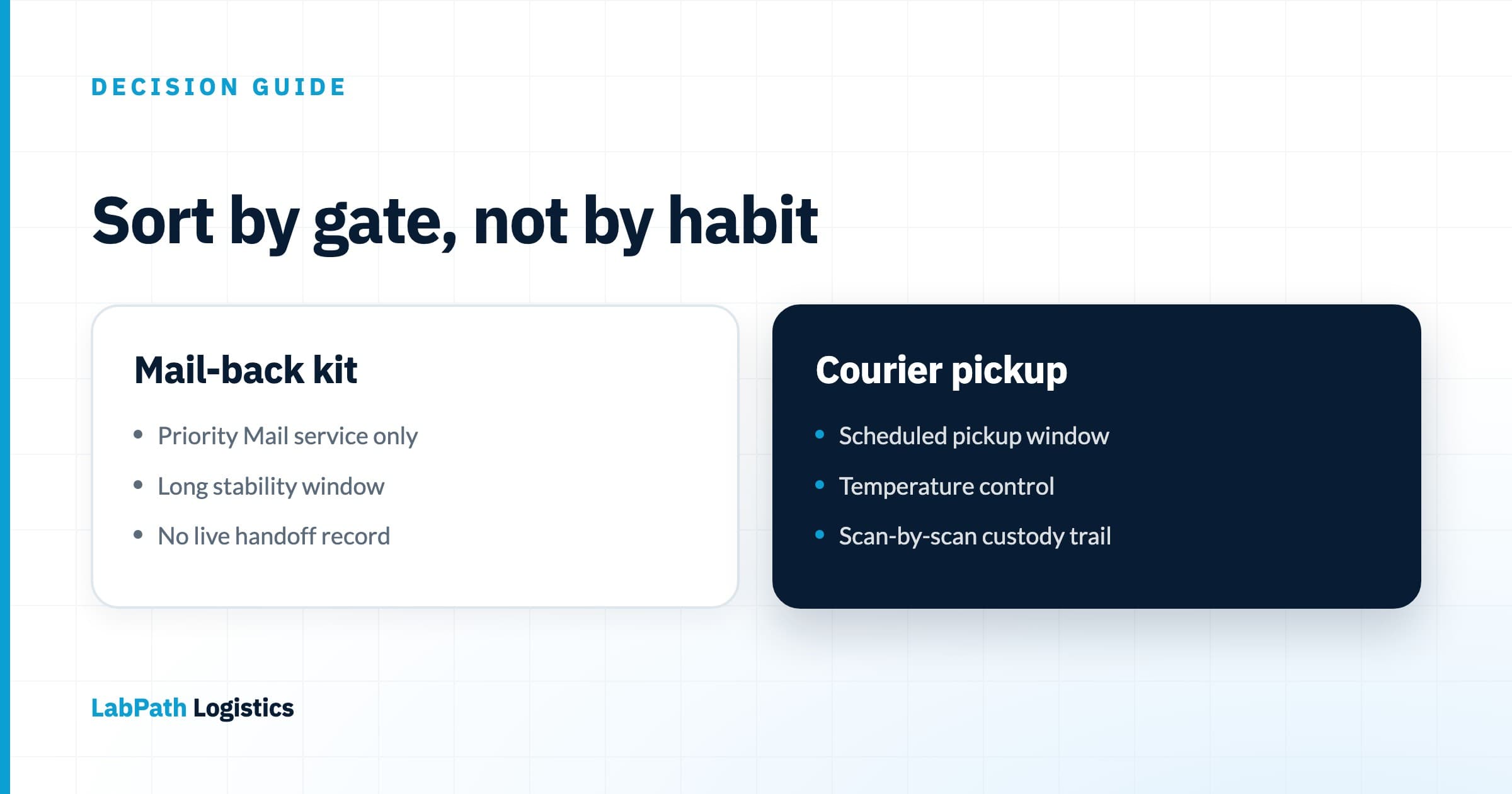
Run a drill. Pick a quiet afternoon, call the backup number on the card, and confirm that someone answers, that they can reach your site within the time you assumed, and that they accept the same packaging and custody log. If you are trialing a new courier, fold the drill into the trial. A short pilot program is the cheapest place to find out whether the second option works.
Keep a log of every use of the card, including near-misses, and review it each quarter. If the same lane triggers it twice in a month, the problem is not bad luck. It is a courier or schedule problem, and the log is your evidence. Our lost specimen guide explains what the follow-up looks like when a miss becomes a loss, and our lockbox guide covers where a specimen waits safely until the backup arrives.
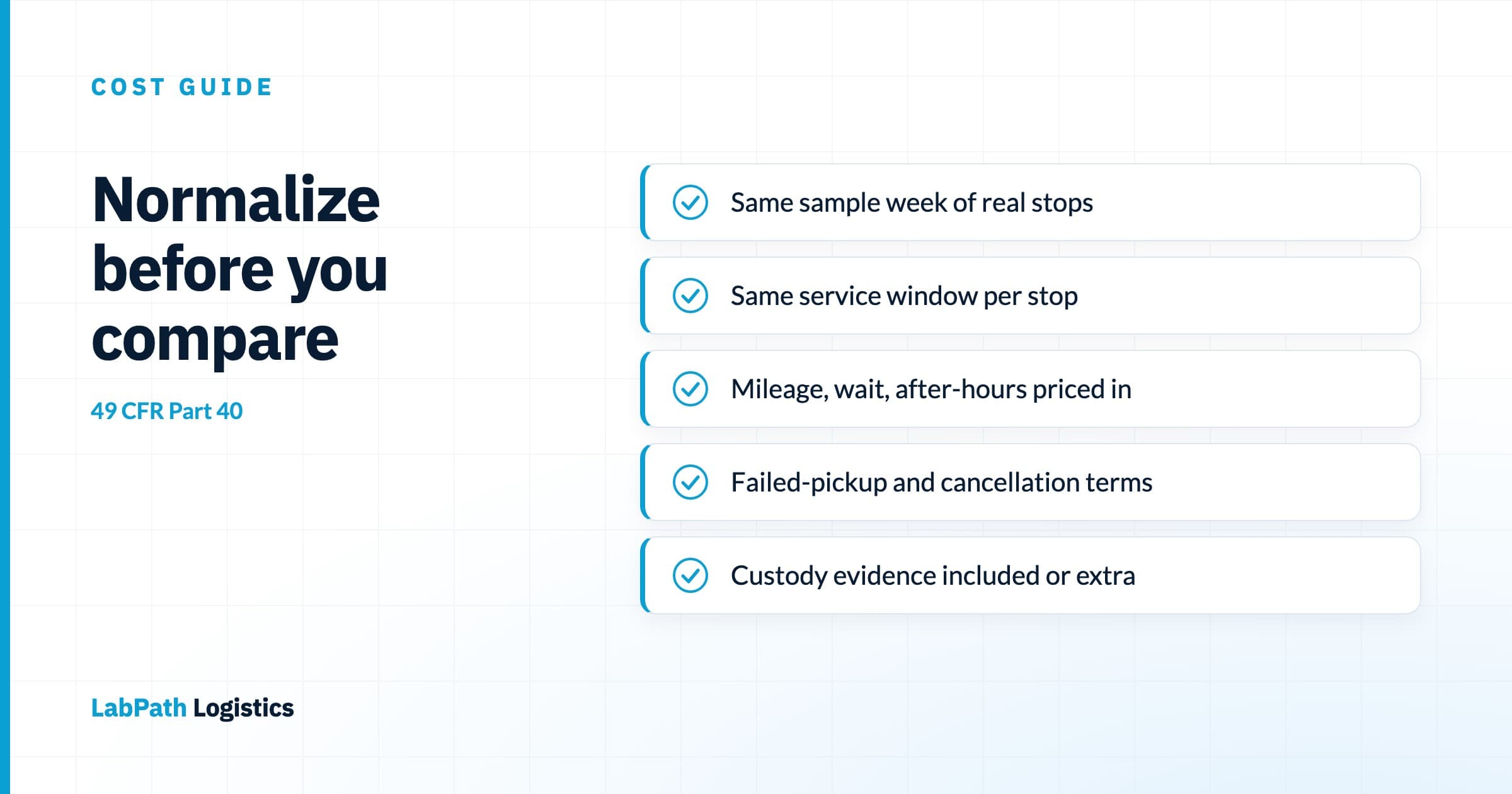
If you are comparing couriers for a new lane, price the lane first. The LabPath estimator gives a nonbinding estimate, and our planned service levels show how scheduled and on-demand options differ. That makes the cost of a second option visible before you need it.
Frequently Asked Questions
What should a medical courier backup plan include?
It should include a trigger time based on the shortest stability limit on the lane, a named second option with a tested phone number, one person authorized to activate it, a custody record that continues through the handoff, and a recollection rule for specimens that fall outside their window.
Does CLIA require a courier backup plan?
CLIA does not use that phrase. Under 42 CFR 493.1242, a laboratory must establish and follow written procedures for conditions for specimen transportation, specimen storage and preservation, and specimen acceptability and rejection, where applicable. A written plan for a failed pickup supports those procedures.
When should a lab call the backup courier?
Work backward from the shortest stability limit on the lane: subtract the backup's arrival time and the trip to the receiving lab, and call at what remains. Do not wait for the end of the courier's pickup window, because the specimen's clock runs regardless of the schedule.
How do you test a courier's contingency plan?
Ask for it in writing, ask who covers a driver absence and how soon you are told, and then run a drill by calling the backup number on a quiet afternoon. A short paid pilot on one route is a low-cost way to see how the courier behaves when something goes wrong.