Medical Courier Contract Terms: 10 Clauses to Redline
October 15, 2026 · By LabPath Logistics Editorial Team, Medical Logistics Desk
Quick Answer
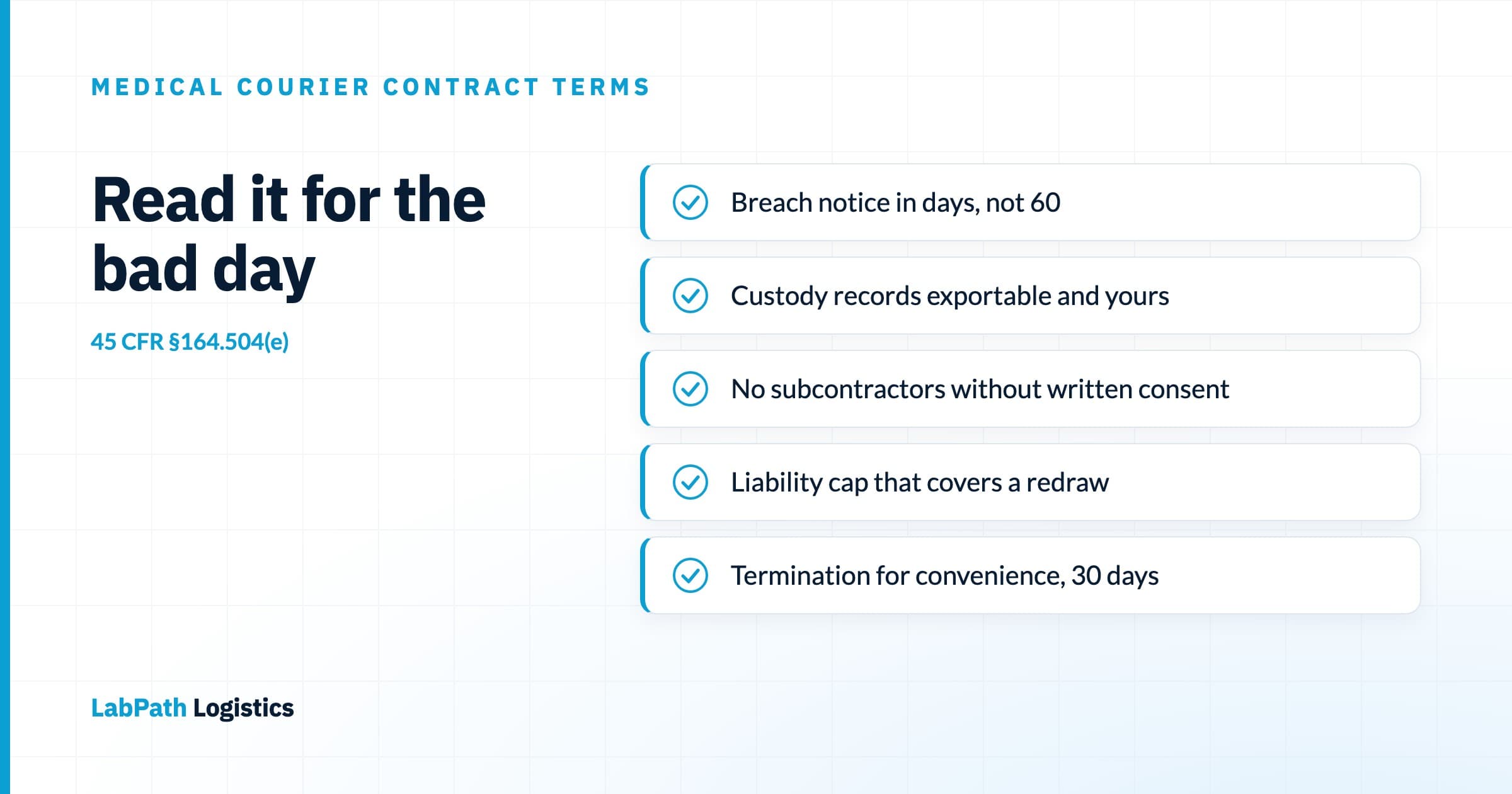
A medical courier contract should be read for the bad day, not the average one. Ten clauses decide what a lost specimen, a breach, or a vendor exit costs you: scope definitions, SLA credits, the fuel surcharge index, the BAA's breach clock, subcontracting, insurance, liability caps, record ownership, auto-renewal, and audit rights.
Most medical courier contracts are read the way they are sold: SLA page first, rate card second, signature third. The clauses that decide what a bad day costs you sit in neither place. They are in the definitions, the business associate agreement, the liability section, and the renewal paragraph nobody reads until they want out. A medical courier contract is a plan for the day a specimen goes missing, and that is how it should be read.
This guide is for the Houston lab manager or practice administrator who has already chosen a courier and is holding the draft. Our RFP checklist covers how to pick the vendor and our SLA guide covers how to measure the clock. This one covers the paper, using a method we call the Bad-Day Redline: for each of ten clauses, ask what it does on the worst plausible day, and redline it until the answer is acceptable.
The Bad-Day Redline: Ten Clauses in Order
The SLA governs the ordinary run. It says nothing about who owns the custody record when you leave, how many days the courier has to report a breach, or whether the driver at your dock tomorrow works for the company you signed with. Those answers live in these ten clauses, and in most drafts they default in the vendor's favor because the vendor wrote the template.
- Scope and definitions. The contract should define each service level it prices (STAT, same-day, scheduled route) and define "delivered" as a timestamped handoff to a named receiver, not a drop at a dock. On the bad day, this clause decides whether a specimen left in a lockbox counts as delivered.
- SLA measurement and credits. Name the clock (dispatch acknowledgment to receiver attestation), the data source (the courier's custody record), and the credit. Credits should be automatic on the invoice, not claimed by you. Our SLA guide has the clock definitions.
- Pricing, accessorials, and the fuel surcharge index. Every accessorial (wait time, redelivery, after-hours) should have a number. The fuel surcharge should name a public index, the week it is read, and a table. Our invoice audit guide explains why the surcharge is the one line you can check.
- The business associate agreement. Federal rules list what it must contain. Redline the breach clock, the subcontractor flow-down, and the return-or-destroy clause, covered below.
- Subcontracting and driver assignment. Require written consent before any run is subcontracted, and require that every driver who touches your specimens has completed the training the contract describes. Our driver training guide lists what that training should include.
- Insurance and indemnity. Require current certificates, your facility as additional insured on the auto policy, and an indemnity that covers the courier's negligence. Texas requires registered motor carriers to hold combined single limit auto liability under 43 TAC §218.16; our insurance guide lists the certificates to request.
- Limitation of liability. Most templates cap the courier's liability at fees paid in a month or less. Carve out breaches of the BAA, gross negligence, and willful misconduct, and set the cap high enough to cover a redraw and a delayed result. Our lost specimen guide walks through what that day actually costs.
- Data and records ownership. Custody events, temperature logs, and proof of delivery are your compliance file. The contract should say they are yours, exportable in a stated format on request, and delivered in full at termination.
- Term, renewal, and exit. Strike silent auto-renewal or shorten it to month-to-month after the initial term, add termination for convenience on 30 to 60 days' notice, and require transition assistance. Our switching couriers guide shows why the exit clause matters more than the entry price.
- Audit rights and reporting. Require a monthly or quarterly performance report and the right to inspect training and custody records on reasonable notice. Our pilot program guide has a six-line scorecard you can attach as an exhibit.
The Bad-Day Redline: save and send to your compliance officer
Ten questions, one per clause: (1) Does "delivered" mean a named receiver and a timestamp? (2) Are SLA credits automatic on the invoice? (3) Is the fuel surcharge tied to a named public index and a table? (4) Does the BAA set a breach notice clock shorter than 60 days? (5) Can the courier subcontract without our written consent? (6) Are we an additional insured, with current certificates on file? (7) Does the liability cap cover a redraw and a delayed result, with BAA breaches carved out? (8) Are custody records ours, exportable, and delivered at exit? (9) Does the agreement auto-renew for a full term, and can we leave for convenience? (10) Can we see the performance report and inspect training records?
Which BAA Clauses Should a Lab Redline?
A business associate agreement is not a formality the courier hands you; it is a contract with required contents. Under 45 CFR §164.504(e)(2), the agreement must establish the permitted uses and disclosures and must require the business associate to do ten listed things, lettered (A) through (J): among them, use appropriate safeguards, report any use or disclosure not permitted by the contract, ensure subcontractors agree to the same restrictions and conditions, make its books and records available to the Secretary of HHS, and at termination return or destroy all protected health information where feasible. The rule also requires the agreement to authorize the covered entity to terminate it if the business associate violates a material term. HHS publishes sample provisions that track this list.
10
required obligations, lettered (A) through (J), that a business associate agreement must impose on the business associate, plus a covered-entity termination right for material breach (45 CFR §164.504(e)(2)(ii) and (iii))
The floor is set by regulation. The redline is about the ceiling. First, the breach clock. Under 45 CFR §164.410(b), a business associate must notify the covered entity of a breach of unsecured protected health information without unreasonable delay and in no case later than 60 calendar days after discovery. Sixty days is the legal maximum, not a reasonable contract term; your own notification duties to patients and regulators run from your discovery, and a courier that waits eight weeks hands you the problem with no runway. Ask for notice within a stated number of business days, with a preliminary report even when the facts are incomplete.
60 days
outer limit for a business associate to notify the covered entity after discovering a breach of unsecured PHI; a contract may, and should, require faster notice (45 CFR §164.410(b))
Second, the subcontractor flow-down. Section 164.504(e)(5) applies the same requirements between a business associate and its own subcontractors, so a partner fleet used for overflow needs a compliant agreement of its own, and your redline should require the courier to produce it on request. Third, scope. The BAA should describe what the courier actually touches, not a generic template. Our HIPAA courier guide covers the conduit question, and our Texas HB 300 guide covers the state layer on top.
What Should the Fuel Surcharge Clause Actually Say?
Name the series, the region, the reading week, and the table. The U.S. Energy Information Administration publishes weekly retail on-highway diesel prices by region, and the Gulf Coast series is the natural index for a Houston agreement. For the week of October 12, 2026, EIA reports Gulf Coast on-highway diesel at $5.809 per gallon, against a U.S. average of $6.179. "Fuel surcharge may be adjusted to reflect market conditions" gives you nothing to reconcile. "The surcharge percentage is set each month from the EIA Gulf Coast weekly on-highway diesel price for the first Monday of the month, per Exhibit C" gives you a number to check in two minutes.
$5.809
per gallon, Gulf Coast (PADD 3) retail on-highway diesel for the week of October 12, 2026, the public index a Houston courier fuel surcharge should name (U.S. Energy Information Administration, Gasoline and Diesel Fuel Update)
Two drafting points. The table should move in both directions; a surcharge that ratchets up but never down is a rate increase in disguise. And the clause should state a floor below which no surcharge applies, so a quiet month does not carry a fuel line out of habit.
A Houston Scenario: A Three-Site Clinic Group Signs Its First Courier
A primary care group with clinics in the Heights, Pearland, and Katy consolidates specimen pickups under one courier after years of staff driving samples themselves. The draft agreement has a clean SLA and a fair rate card. Running the Bad-Day Redline, the administrator finds three things: "delivered" is undefined, the BAA repeats the 60-day statutory maximum for breach notice, and the term auto-renews for twelve months unless cancelled 90 days before the anniversary.
None of those is a reason to walk away. Each is a reason to redline. Delivered becomes a timestamped receiver attestation. Breach notice becomes five business days with a preliminary report. Auto-renewal becomes month-to-month after year one with 30 days' notice either way. The courier agrees to all three in a day, because none of them changes how it runs a route. They only change what happens on the day something goes wrong, which is the day the contract exists for.
What Does a Courier Draft That Needs Few Redlines Look Like?
It defines service levels the way it prices them, treats custody records as your compliance file, scopes its BAA to what the courier touches with a notice clock in days, names its fuel index, and lets you leave. A courier whose booking model has no patient fields, and whose custody record carries an order reference and a status, has less to protect and less to argue about. That is the design principle behind LabPath Logistics; our privacy engineering notes and planned service levels show how it works.
Before the redline comes the number. The nonbinding estimator prices a Houston lane by service level so you know what the agreement is worth before you spend an afternoon marking it up.
Frequently Asked Questions
What should be in a medical courier contract?
At minimum: defined service levels with a definition of "delivered"; SLA clocks and automatic credits; a full accessorial schedule and a fuel surcharge tied to a named public index; a business associate agreement meeting 45 CFR §164.504(e); subcontracting limits; insurance certificates and indemnity; a limitation of liability with carve-outs for BAA breaches and gross negligence; customer ownership of custody and temperature records; a renewal and termination-for-convenience clause; and audit and reporting rights.
Does a medical courier need a business associate agreement?
Usually yes, when the courier is more than a conduit and has routine access to protected health information such as requisitions or labeled specimens. The agreement must contain the elements in 45 CFR §164.504(e)(2), including safeguards, breach reporting, subcontractor flow-down, and return or destruction of PHI at termination. The narrow scope of what the courier actually touches should be written into the agreement rather than assumed.
How quickly must a courier report a HIPAA breach?
Under 45 CFR §164.410(b), a business associate must notify the covered entity without unreasonable delay and in no case later than 60 calendar days after discovering a breach of unsecured PHI. That is a legal outer limit. A contract can require faster notice, and most facilities should ask for a stated number of business days with a preliminary report.
How should a courier fuel surcharge be calculated?
By reference to a named public index, a stated reading date, and a published table that moves in both directions. For Houston agreements, the U.S. Energy Information Administration's weekly Gulf Coast retail on-highway diesel price is the natural index. The clause should also state a floor price below which no surcharge applies.