Staff Driving Specimens in Their Own Cars: Houston Rules
October 10, 2026 · By LabPath Logistics Editorial Team, Medical Logistics Desk
Quick Answer
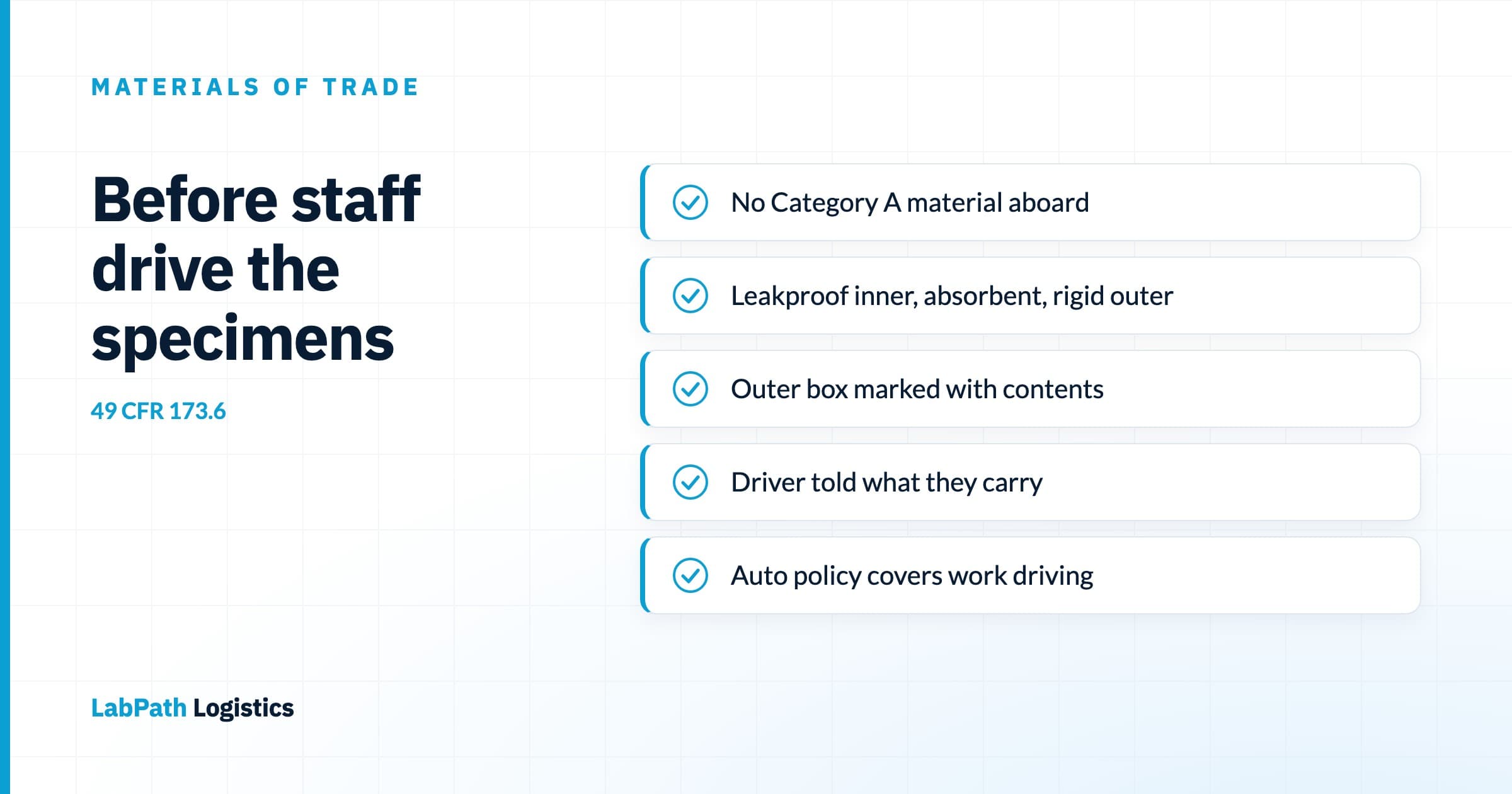
Usually yes. Under DOT's Materials of Trade exception (49 CFR 173.6), a clinic employee may carry Category B and exempt specimens in a work or personal vehicle without full hazmat shipping rules, if the packaging is triple-layer and leakproof, the outer box is marked, the driver knows what is aboard, and nothing is Category A. Insurance is a separate question.
Somewhere in Greater Houston tonight, a medical assistant will put a bag of specimens on the passenger seat and drop it at a lab on the way home. Most clinics assume that is either completely fine or completely illegal. It is neither. Transporting specimens in a personal vehicle is allowed under a specific federal exception, but only when five conditions hold, and the one most clinics never check is not a DOT rule at all. It is the staff member's auto insurance policy.
This guide is for practice managers, clinic administrators, and lab supervisors who already have staff driving specimens, or are about to ask someone to. It explains the DOT Materials of Trade exception in plain language, where OSHA's bloodborne pathogens standard still applies, and gives you the Glovebox Test, five yes-or-no checks to run before anyone drives a specimen anywhere.
Is It Legal for Clinic Staff to Drive Specimens?
Federal hazardous materials rules cover diagnostic specimens that may contain pathogens. Normally that means the full shipping regime: classification, specified packaging, marking, and documentation. But DOT carves out a lighter path called materials of trade. Under 49 CFR 171.8, a material of trade includes hazmat carried "by a private motor carrier … in direct support of a principal business that is other than transportation by motor vehicle." A clinic whose business is patient care, moving its own specimens in its own staff's car, fits that description.
When the conditions in 49 CFR 173.6 are met, a material of trade "is not subject to any other requirements of this subchapter besides those set forth or referenced in this section." That is the whole appeal. No shipping papers, no placards, no hazmat employee training program in the formal sense. The trade is that you must meet every condition in the section, every time.
0.5 L
Maximum per inner container for Division 6.2 specimens carried as materials of trade, packed in an outer box of no more than 4 kg or 4 L, per 49 CFR 173.6(a)(4)
What Does the Materials of Trade Exception Require?
Paragraph (a)(4) of 173.6 covers "a Division 6.2 material, other than a Category A infectious substance, contained in human or animal samples" moved for research, diagnosis, or treatment. Read that carefully. It covers routine blood, urine, swabs, and tissue that would ship as Category B or exempt specimens. It does not cover Category A material under any circumstances. Our Category B packaging guide explains how to tell the difference.
- Combination packaging: a leakproof inner container, enough absorbent material to soak up the entire liquid contents, and a strong, tight outer packaging that is securely closed and secured against shifting in the vehicle.
- Quantity limits: inner containers of no more than 0.5 kg or 0.5 L each, in an outer packaging of no more than 4 kg or 4 L. A single larger inner container of up to 16 kg or 16 L in one outer is also allowed.
- Marking: the outer packaging must be marked with a common name or proper shipping name that identifies what is inside.
- Driver notice: the person operating the vehicle "must be informed of the presence of the hazardous material."
- Vehicle total: all materials of trade on one vehicle may not exceed 200 kg (440 pounds) combined.
For a clinic, the packaging line is where the exception usually fails. A biohazard bag on the passenger seat is not combination packaging, and a cooler sliding around the footwell is not secured against shifting. The fix is cheap: a rigid lidded transport box with absorbent pads, strapped or wedged in place, and a printed label on the lid.
Does OSHA Still Apply When Staff Drive?
Yes. The DOT exception relaxes hazmat transport rules. It does nothing to OSHA's protections for the employee doing the driving. The bloodborne pathogens standard requires that specimens be placed in a container that prevents leakage "during collection, handling, processing, storage, transport, or shipping," and that the container be labeled or color-coded and closed before it moves. If the primary container could be punctured or is contaminated on the outside, it goes inside a puncture-resistant secondary container.
OSHA also allows a facility using universal precautions to skip specimen labels while specimens stay inside the facility. Once a specimen leaves in a staff member's car, it has left the facility. The transport box needs its biohazard label. Our DOT and OSHA guide covers how the two rule sets fit together, and what a spill kit in the vehicle should contain.
Will the Employee's Auto Insurance Cover It?
This is the check nobody runs, and it is the one with the largest downside. The Texas Department of Insurance puts it plainly in its consumer guidance on deliveries: some personal auto policies may cover an accident during a paid delivery, but "other personal use policies won't cover driving for business." TDI's advice is to "always tell your insurance company if you're driving for business," because otherwise "the company could deny your claims, and you'd have to pay."
Picture the claim. Your employee is rear-ended on the Katy Freeway with your specimens aboard, during a trip you asked them to make. Their insurer asks why they were on the road. If the answer is a work errand their policy excludes, the question of who pays lands back on the clinic, and you may not have hired and non-owned auto coverage to catch it. Ask your broker that question in writing. Our courier insurance guide lists the coverage lines a professional courier should carry, which doubles as a checklist for what your staff do not have.
The Glovebox Test: save and send this
Before any staff member drives a specimen, five answers must be yes. (1) Nothing aboard is Category A. (2) Packaging is a leakproof inner container, absorbent material, and a rigid outer box secured against shifting. (3) The outer box is marked with what it contains and carries a biohazard label. (4) The driver has been told what they are carrying and has a spill kit. (5) The driver's auto policy, or the clinic's hired and non-owned coverage, covers this trip in writing. Any no means the trip should not happen as planned. Forward this to your practice manager and ask which number fails today.
A Houston Scenario: The 5:15 p.m. Drop-Off
Consider a family practice off the Grand Parkway in Katy. The reference lab's courier comes at 2:30 p.m. Anything collected after that waits overnight, unless a medical assistant drives it to a lab near the Texas Medical Center on the way home. It happens three or four times a week. The MA uses a biohazard bag inside a grocery tote. No one has asked about her insurance. Run the Glovebox Test and the practice passes check one and fails two through five.
The clinic has two honest options. It can make the run compliant: buy proper transport boxes, label them, train the MA, confirm coverage with its broker, and reimburse mileage. The IRS business standard mileage rate rose to 76 cents per mile effective July 1, 2026, per the Journal of Accountancy, so a 40-mile round trip reimburses at $30.40 before anyone counts her time. Or it can move the late collections to a scheduled late-afternoon courier stop and take the trip off her commute entirely. Our pickup schedule guide shows how to size that stop.
When Should a Clinic Stop Using Staff Drivers?
The Materials of Trade exception is built for occasional runs incidental to a clinic's real business. It is a poor fit once the pattern becomes routine. Three signals say it is time to price a courier instead:
- The run happens on a schedule. A trip that recurs every weekday is a route, and routes are cheaper bought than improvised.
- Specimens are time or temperature sensitive. Staff on a commute will stop for gas and sit in traffic. Our specimen temperature guide covers what that does to results.
- You cannot produce a custody record. If a specimen goes missing from a personal car, there is no scan trail. Our lost specimen guide walks through what that costs.
If any of those apply, compare the full cost of the staff run against a scheduled stop. Our in-house vs. courier guide lays out the hidden costs, and the LabPath estimator gives a nonbinding number for the same route without signup. If your clinic already sends to more than one place, the Destination Count is worth running first.
Frequently Asked Questions
Can an employee transport lab specimens in their personal car?
Generally yes, under DOT's Materials of Trade exception in 49 CFR 173.6, for Category B and exempt human specimens. The specimens must be in leakproof combination packaging within quantity limits, the outer box must be marked, the driver must be told what is aboard, and no Category A material may be carried.
Does the Materials of Trade exception cover Category A infectious substances?
No. Paragraph (a)(4) of 49 CFR 173.6 expressly excludes Category A infectious substances. Those must travel under the full hazardous materials regulations, with specified packaging, documentation, and trained personnel.
Does personal auto insurance cover driving specimens for work in Texas?
It depends on the policy. The Texas Department of Insurance says some personal policies cover business driving and others do not, and that failing to tell your insurer you drive for business could lead to a denied claim. Confirm coverage in writing with the insurer or the clinic's broker before staff drive.
Do specimens need a biohazard label when staff drive them?
Yes, once they leave the facility. OSHA's bloodborne pathogens standard requires transport containers to be closed and labeled or color-coded. The universal-precautions labeling exemption applies only while specimens remain inside the facility.