New Medical Courier? Ask for Proof, Not Years in Business
October 16, 2026 · By LabPath Logistics Editorial Team, Medical Logistics Desk
Quick Answer
Judge a new medical courier on evidence, not tenure. Before a pilot, ask it to show seven things: a live custody record from a test run, driver training records, insurance certificates naming you, a scoped BAA, its packaging procedure, a named backup plan, and exit terms that return your records. A courier that can show all seven is ready to be tested.
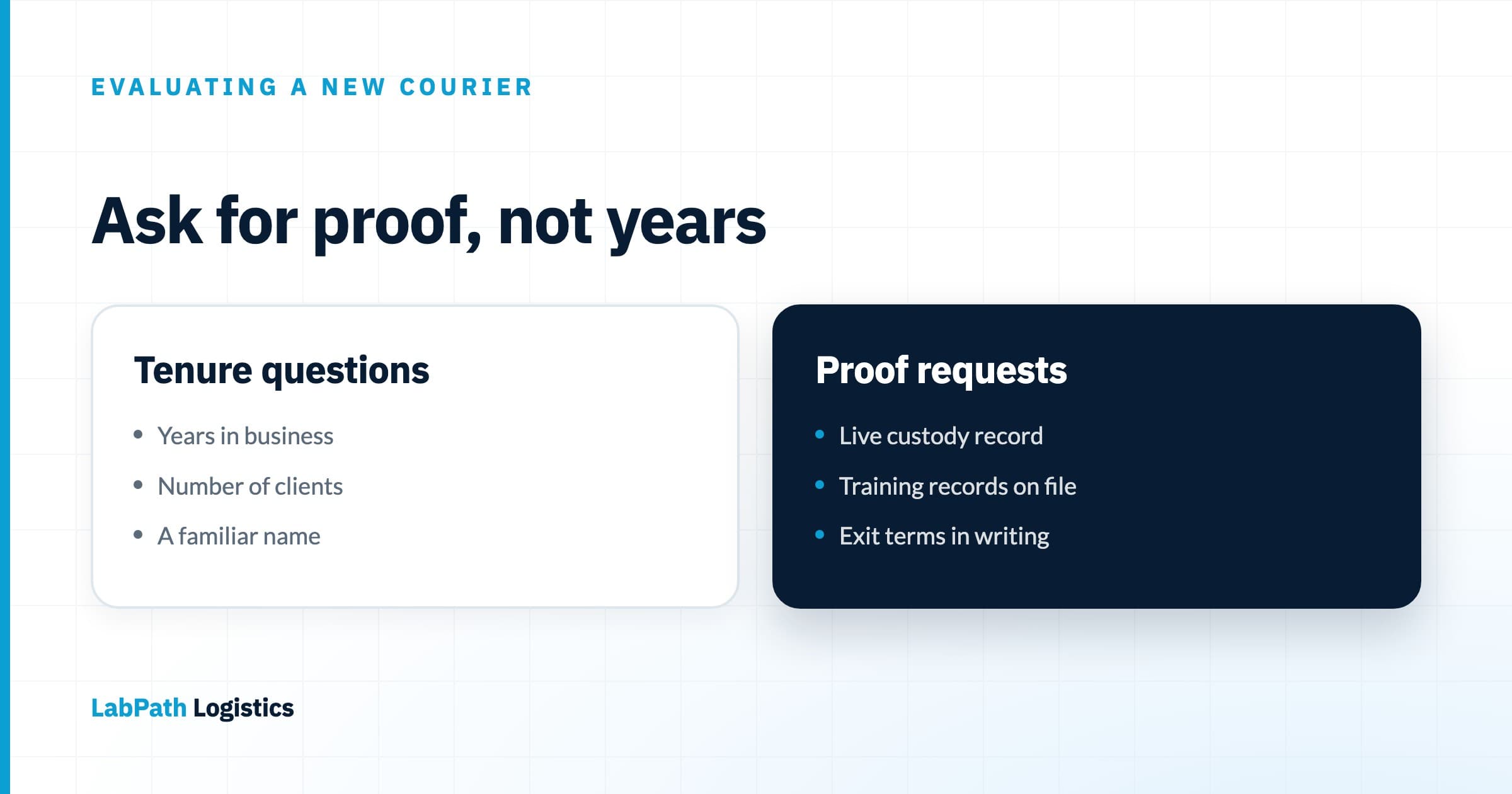
"How long have you been in business?" is the first question most Houston labs ask a new medical courier, and it is the least useful one. Tenure feels like evidence because it stands in for things you cannot see from a sales call: drivers who are trained, records that exist, insurance that pays, a plan for the day a driver calls in sick. Fifteen years in business does not prove any of them. A new medical courier can prove all of them, if you ask for the right things.
This guide is for the lab manager, practice administrator, or pharmacy director who has a newer courier on the shortlist and an incumbent with a longer history. It gives you a method we call the Proof-Over-Tenure Test: seven requests that replace the tenure question with evidence, plus the one contract term that covers the risk tenure was really pointing at.
Is a New Medical Courier Riskier Than an Established One?
In one specific way, yes, and it is worth naming. New businesses close more often than old ones. That risk is real, but it is a continuity risk, not a quality risk, and you manage it in the contract rather than by refusing to look. Quality risk, meaning lost specimens, missing records, untrained drivers, is not reliably lower at an older courier. It is lower at a courier that can show its work.
77.9%
of private-sector establishments that opened in the year ending March 2024 were still operating a year later, so roughly one in five did not make it (U.S. Bureau of Labor Statistics, Business Employment Dynamics, Table 7)
The Bureau of Labor Statistics survival table covers all industries, not couriers specifically, so read it as a base rate rather than a forecast for any one vendor. The practical conclusion is not "avoid new couriers." It is "make sure your records and your exit survive the courier." That is proof number seven below.
The Proof-Over-Tenure Test: Seven Things to Ask a New Courier to Show
Each request asks to see something, not to hear about it. A courier that answers with a description instead of a document has told you what you need to know.
- A live custody record. Ask for a test run from your dock to your lab with a dummy package, then ask for the record: who scanned it, when, at which handoff, and who attested receipt. Our chain of custody guide lists the events a complete record should carry.
- Training records for the drivers you will actually get. OSHA's bloodborne pathogens standard requires training at initial assignment and at least annually after that, and requires training records to be kept for three years. Ask to see them for named drivers, not a policy binder. Our driver training guide covers what else the curriculum should include.
- Insurance certificates that name you. Current certificates for auto liability and general liability, with your facility listed as additional insured, issued by the agent rather than pasted into a slide. Our insurance guide lists the coverages to request.
- A BAA scoped to what the courier touches. Ask for the draft before the pilot, and read the breach notice clock and subcontractor clause first. Our contract terms guide shows how to redline both.
- A written packaging and handling procedure. How the courier keeps Category B specimens in compliant triple packaging, how it holds temperature, and what the driver does when a package arrives at the vehicle leaking. Our Category B packaging guide is the reference.
- A named backup plan. Who covers your 4:30 p.m. pickup when the assigned driver is out, and how you are told. A new courier with a small team should have a better answer here, not a vaguer one. Our backup plan guide shows what a real one looks like.
- Exit terms in writing. Termination for convenience on short notice, and custody and temperature records delivered to you in a stated format at exit. This is the clause that answers the base rate above.
The Proof-Over-Tenure Test: save and send to your lab director
Ask any courier, new or old, to show: (1) a custody record from a test run at our site; (2) bloodborne pathogens training records for the drivers assigned to us, initial and annual; (3) insurance certificates naming us as additional insured; (4) a draft BAA with a breach notice clock in days; (5) the written packaging and temperature procedure; (6) the named backup for each of our pickup windows; (7) exit terms with termination for convenience and records returned to us. Seven documents. A courier that produces them is ready for a pilot.
Why Ask for Training Records Instead of a Training Policy?
Because the regulation is about records, not intentions. Under 29 CFR 1910.1030(g)(2), employers must provide bloodborne pathogens training at the time of initial assignment to tasks with occupational exposure and at least annually thereafter, and paragraph (h)(2) requires training records to be kept for three years from the date of training. A courier of any age either has those records for the drivers on your route or does not.
3 years
retention period for bloodborne pathogens training records, which must show training at initial assignment and at least annually after (OSHA, 29 CFR 1910.1030(g)(2) and (h)(2))
This request cuts both ways, which is why it is useful. An established courier with high driver turnover may struggle to produce current records for whoever is assigned this month. A new courier with a small, stable team may produce them in an afternoon. The question measures the thing you care about, not the proxy.
A Houston Scenario: Two Finalists, One Clinic
A multi-specialty clinic in Sugar Land is replacing staff drop-offs to a reference lab near the Texas Medical Center. Two couriers make the shortlist: one that has run Houston routes for over a decade, and one that launched recently. The administrator's first instinct is to pick the older name and move on.
Instead, she sends both the seven requests. The established courier returns certificates and a BAA quickly, but its custody record from the test run is a signature on a paper manifest, and it cannot say which driver will cover the afternoon window. The newer courier returns a scan-by-scan record and named training files, but its draft agreement auto-renews for a year. She redlines the renewal to month-to-month, adds a records-at-exit clause, and runs a 14-day pilot with the newer courier. Neither courier was disqualified by its age. Each was judged by what it could show.
What Comes After the Seven Proofs?
A pilot. Documents tell you a courier is ready to be tested; only runs tell you how it performs on your lanes, at your pickup times, in Houston traffic. Our pilot program guide has a six-line scorecard for a 14-day trial, and our RFP checklist covers the wider selection if you are running a formal process. Price the lane first with the nonbinding estimator so the pilot has a cost baseline.
LabPath Logistics is a new courier, so we apply this test to ourselves. Our booking-to-receiver-attestation workflow, including package QR scans, append-only custody events, and receiver signature, is verified locally; production dispatch, GPS, and temperature telemetry are not live yet. The booking model has no patient fields, by design. Our platform preview and privacy engineering notes say exactly what is verified and what is not, which is the kind of answer this test is meant to surface.
Frequently Asked Questions
Should a lab use a new medical courier?
It can, if the courier can show evidence rather than history: a custody record from a test run, driver training records, insurance certificates naming the facility, a scoped BAA, a written packaging procedure, a named backup plan, and exit terms that return records. Manage the continuity risk with termination for convenience and records-at-exit clauses, then run a short pilot before committing.
What documents should I request from a medical courier?
Request current insurance certificates with your facility as additional insured, a draft business associate agreement, bloodborne pathogens training records for assigned drivers, the written packaging and temperature-handling procedure, a sample custody record from a test run, a backup coverage plan, and the draft service agreement with its termination and renewal terms.
How often must medical couriers receive bloodborne pathogens training?
Under OSHA's bloodborne pathogens standard, 29 CFR 1910.1030(g)(2), employees with occupational exposure must be trained at the time of initial assignment and at least annually thereafter. Training records must be kept for three years from the date of training under paragraph (h)(2).
How do I protect my facility if a new courier goes out of business?
Write it into the agreement. Require termination for convenience on short notice, avoid long auto-renewal terms, and require that custody, temperature, and delivery records belong to you and are delivered in a stated format at termination. Keep a named backup option for critical pickup windows so a vendor exit does not become a service gap.