Synovial Fluid Transport in Houston: Labs Disagree
October 28, 2026 · By LabPath Logistics Editorial Team, Medical Logistics Desk
Quick Answer
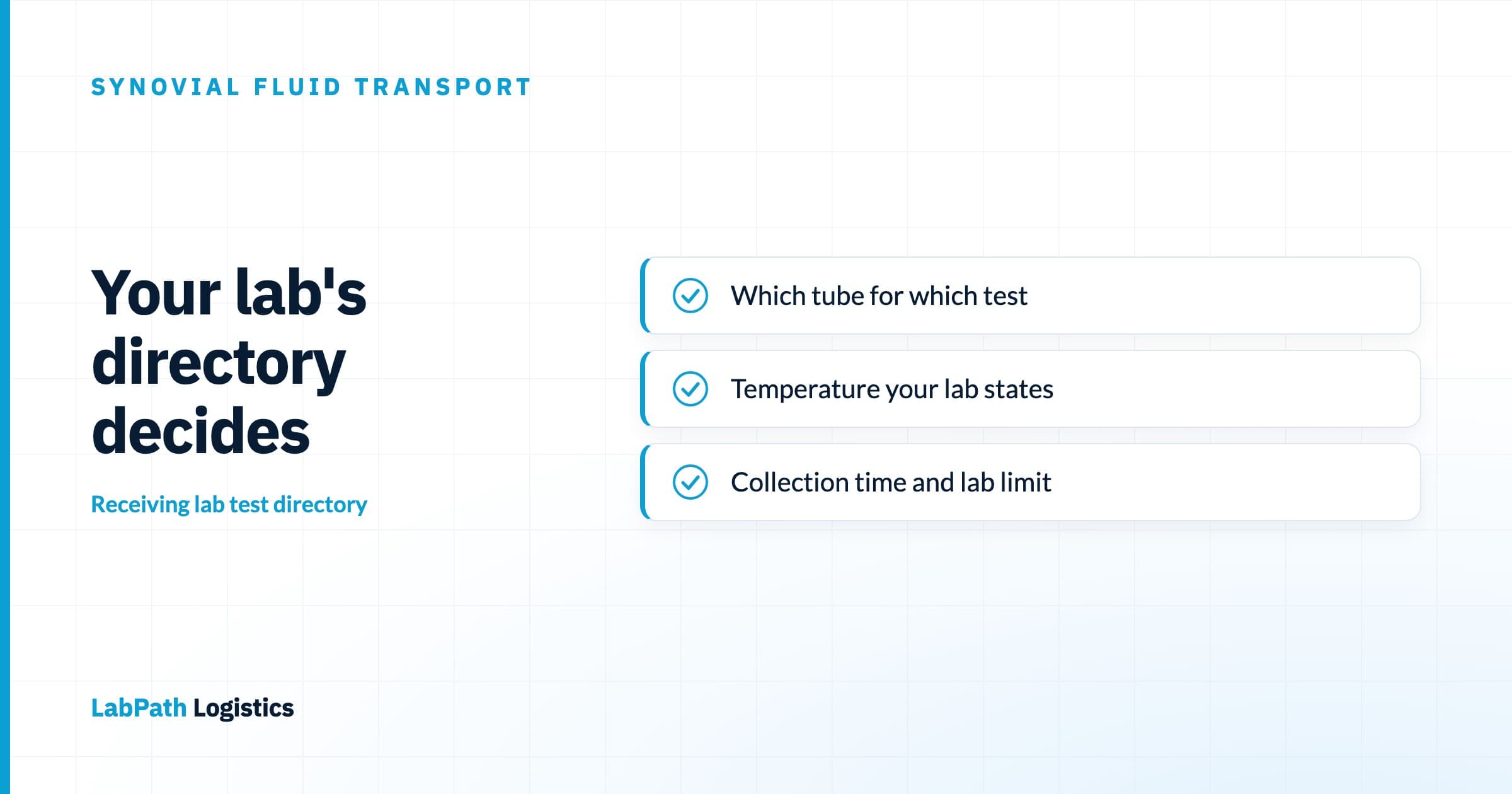
Synovial fluid has no single transport rule. Labcorp's directory says refrigerate and lists room temperature as unstable, while a CAP Today Q&A says room temperature transport is fine. Do not guess: write your receiving lab's temperature, tube, and time limit on the label, then pick the courier lane that fits that limit.
Ask two labs how to send joint fluid and you can get opposite answers. That is the problem with synovial fluid transport in Houston: the usual courier habit of "put it in the cooler" is right for some directories and wrong for others, and nobody at the pickup can tell which one applies.
This guide gives you the Joint Fluid Card, three lines that settle temperature, tube, and the lab's clock before the aspirate leaves the exam room. It covers logistics only. What to order and how to collect belong to your clinicians and the receiving laboratory.
Should Synovial Fluid Go to the Lab Cold or at Room Temperature?
It depends on the lab and the test, and published sources conflict. Labcorp's directory for synovial cell count with crystals says to refrigerate, lists room temperature as unstable, lists refrigerated as stable for 2 days, and rejects specimens older than 48 hours. A CAP Today Q&A says synovial fluid can be transported and stored at room temperature, in an anticoagulant so it does not clot, and examined quickly.
A microbiology reference, Microbe Online, adds the part couriers miss: one aspirate that is split across several tests cannot follow one rule, and if delivery will be delayed, call the lab before storing the sample.
2 days vs. same day
Labcorp lists refrigerated stability of 48 hours for its synovial crystal cell count; the CAP Today Q&A advises examining synovial fluid quickly at room temperature. Same specimen, different rules, so the receiving lab's directory is the only one that counts.
What Is the Joint Fluid Card?
The Joint Fluid Card: save and send to your procedure lead
(1) Whose rule: name the receiving lab and copy its temperature instruction for each test on the order, because a split aspirate can carry mixed rules. (2) Which tube: the lab's directory says which anticoagulant goes with the cell count, the crystal exam, and the culture, so the label must match it. Do not swap tubes to save a stick. (3) The lab's clock: write the collection time on the label with the lab's limit beside it, then count back to the latest pickup. If any line is blank when the needle comes out, the courier is guessing.
Why Does a Wrong Default Cost You the Specimen?
Joint aspirates are small and hard to repeat. The same CAP Today Q&A notes that anticoagulant choice can affect crystal results: lithium heparin can mimic calcium pyrophosphate crystals and oxalate can form calcium oxalate crystals. A courier cannot see any of that, which is why the tube and temperature must be settled before pickup, not at it.
Labcorp's directory also rejects frozen specimens, specimens older than 48 hours, and gel-barrier tubes. Those are rejection reasons a clinic can prevent with one glance at the label. Our specimen rejection guide covers how rejections turn into repeat procedures, and the temperature guide explains why the handling class comes from the test, not from the cooler.
Packaging still applies either way. Diagnostic specimens shipped as UN3373 Category B use the triple packaging in 49 CFR 173.199. Room temperature does not mean loose in a tote. See our Category B packaging guide.
A Houston Scenario: The Friday Knee Aspiration
An orthopedic clinic in the Medical Center aspirates a swollen knee at 3:15 p.m. on a Friday. Staff split the fluid into a cell count tube and a culture container, and both go in the cooler for the 5 p.m. scheduled stop. The reference lab's directory says room temperature for culture and gives the cell count a short window. By the time the specimen is received, the culture has been chilled and the count is stale.
With a Joint Fluid Card, line one names the lab, line two shows two tubes with two rules, and line three sets a latest-pickup time that the 5 p.m. stop cannot meet. The decision stops being "the 5 p.m. stop" and becomes a dedicated run that leaves when the tubes are ready. For similar Friday gaps, see our urgent care lab courier guide.
Scheduled Stop, Shared Route, or Dedicated Run?
- Scheduled stop: fits when the lab's limit is long enough to absorb the route, such as a 24- or 48-hour window and a cooler instruction that matches your lab. Confirm both, not just the clock.
- Shared route: works if the stop is timed to your aspiration hours and you have the real stop order. Ask for the order, not the average.
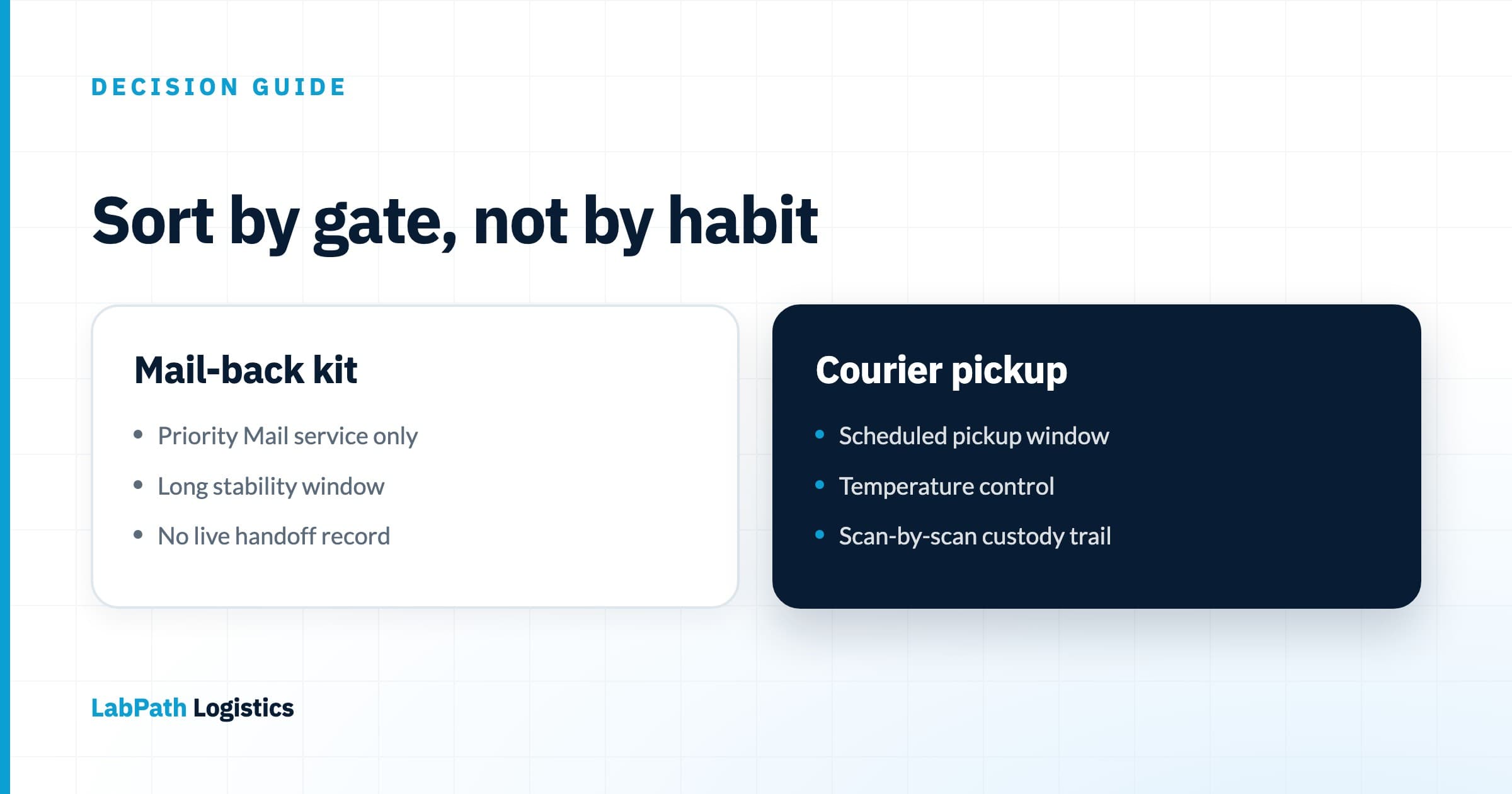
- Dedicated run: fits when the limit is short, the order is split across tubes with different rules, or the aspiration happens late in the day. The courier leaves when the tubes are ready. Our shared vs. dedicated route guide compares the tradeoffs, and our pickup schedule guide shows how to size standing stops.
Price the dedicated option before you need it. The public rate card on our services page lists STAT from $95, with mileage and handling adjustments, and the nonbinding estimator prices your actual lane. Estimates are not booking quotes. For the fastest version of this same decision, see our CSF specimen guide, where the clock is shorter still.
LabPath Logistics is in early access for Greater Houston. Our booking-to-receiver-attestation workflow, including package QR scans, append-only custody events, and receiver signature, is verified locally; production dispatch, GPS, and temperature telemetry are not live yet. The booking model has no patient fields, by design. See our platform preview and privacy engineering notes for exactly what is verified.
Frequently Asked Questions
Should synovial fluid be refrigerated for transport?
It depends on the receiving lab. Labcorp's synovial crystal cell count directory says to refrigerate and lists room temperature as unstable, while a CAP Today Q&A says room temperature transport is acceptable. Follow your own lab's directory for each test on the order.
How long can a joint fluid specimen wait before it reaches the lab?
Labs set different limits. Labcorp's directory rejects specimens older than 48 hours for its synovial crystal cell count, and the CAP Today Q&A advises examining synovial fluid quickly. Use the limit in your receiving lab's directory and write it on the label.
Can one scheduled courier stop carry a split joint aspirate?
Only if every tube's rule fits the same cooler setting and the stop falls inside the shortest time limit. When the tubes have different rules or the limit is short, a dedicated run that leaves when the tubes are ready is usually the safer lane.
Does the courier need patient information for a synovial fluid pickup?
No. A courier needs a pickup address, a destination, a ready time, and a handling instruction. Requisitions and patient identifiers stay with the clinic and the receiving lab.