Opening a Clinic in Houston? Book the Lab Courier First
October 26, 2026 · By LabPath Logistics Editorial Team, Medical Logistics Desk
Quick Answer
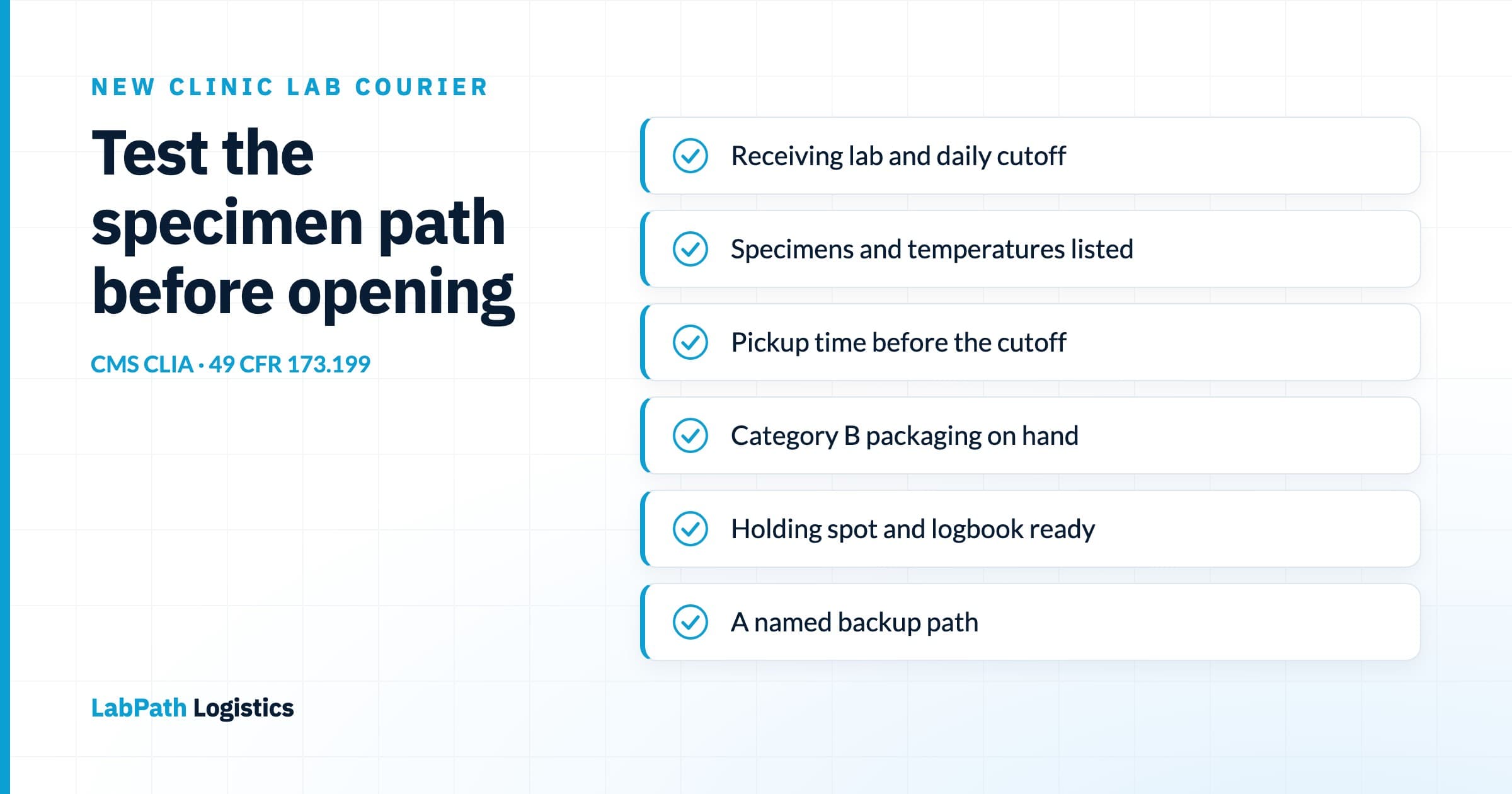
Set up lab courier service before a new clinic opens, not after the first draw. Confirm the receiving lab and its daily cutoff, the specimens and temperatures you will send, a pickup time set against that cutoff, packaging that meets DOT Category B rules, a holding spot, and a backup path. Then choose lab-provided, staff, or independent courier service.
Most new clinic checklists cover the EHR, credentialing, signage, and the phone tree. Lab courier setup for a new Houston clinic usually lands in a week-one email: "Who picks up the tubes?" By then the first patient has already been drawn, the specimen is sitting on a counter, and nobody knows the lab's cutoff.
This guide gives you the Opening-Day Specimen Sheet: six lines to fill in before you open. Once the lines are filled, the courier decision mostly makes itself. It covers logistics only. Which tests to order and which lab to use belong to your medical director and the receiving laboratory.
Why Set Up the Specimen Path Before Opening Day?
Because transport is part of the result. Most lab errors happen before the specimen is analyzed. In a ten-year follow-up study of a hospital STAT laboratory, Carraro and Plebani found that most confirmed errors were preanalytical: problems with collection, labeling, handling, and transport, not the analyzer.
61.9%
of 160 confirmed laboratory errors were preanalytical, compared with 15% analytical and 23.1% postanalytical (Carraro P, Plebani M. Clinical Chemistry, 2007)
A new clinic is most exposed to that phase in its first weeks. Staff are new to each other, collection rooms are not yet routine, and nobody has learned which tubes the lab rejects. A specimen path set up before opening gives you one less thing to improvise.
What Is the Opening-Day Specimen Sheet?
It is six questions to answer, in writing, before the first patient. Each line gives the courier, the lab, and your front desk the same facts.
The Opening-Day Specimen Sheet: save and send to your practice manager
(1) Receiving lab and daily cutoff: which lab, which address, and the latest time it accepts same-day specimens. (2) What you will send: list each specimen type and its temperature, such as room temperature, refrigerated, or frozen, from the lab's test directory. (3) Pickup time: a fixed time set before that cutoff, with travel time, plus who to call for an extra pickup. (4) Packaging: Category B supplies and absorbent material on hand, and who checks them. (5) Holding spot: where specimens wait before pickup, the specimen refrigerator if needed, and a pickup logbook with times. (6) Backup path: who moves specimens if the courier misses, and the lab's rule for late arrivals. If any line is blank on opening day, that is the line that fails first.
Which Lab, Which Cutoff, Which Specimens?
Lines one and two come from your lab agreement, not the courier. Ask the receiving lab for its same-day receiving cutoff and its test directory listings for the tests you expect to order most. A clinic that runs some waived testing in-house still needs a plan for everything it sends out. CMS tells facilities to apply for the CLIA certificate that matches the highest level of test complexity they perform, and anything above that level leaves the building.
Write the temperature next to each specimen type. A mix of room-temperature tubes and refrigerated specimens means the courier order needs two handling classes, not one. Our specimen transport temperature guide explains the ranges.
How Do You Set Pickup Time, Packaging, and a Backup?
- Pickup time: work back from the lab's cutoff. Subtract the realistic drive time for that hour on the route you will actually use, then a buffer. A pickup that only works when traffic is light is not a pickup time. Our specimen pickup schedule guide shows how to set it.
- Packaging: diagnostic specimens shipped under UN3373 use the triple packaging in 49 CFR 173.199: a leakproof primary container, a leakproof secondary, absorbent material, and a rigid outer package. See our Category B packaging guide.
- Holding spot: one labeled place where every outbound specimen waits, with a logbook that records collection time, pickup time, and who handed it off. A lockbox can help after hours.
- Backup: name a person and a method for a missed pickup. If the backup is a staff member driving, read our guide to staff driving specimens in a personal car first, and set up a courier backup plan for the rest.
A Houston Scenario: The Katy Clinic That Opened on a Monday
A new primary care practice off the Grand Parkway in the Katy area opens on a Monday. The lab account was signed, and the lab said its route "covers the area." On day one the medical assistant draws six patients by 3 p.m. Nobody knows the route's pickup time. The lab's route driver came through at 11 a.m., before the first patient. The tubes wait overnight in the break-room refrigerator, and two of them are not stable that long.
With the Opening-Day Specimen Sheet, the gap shows up two weeks earlier. Line three asks for a fixed pickup time, and the practice learns that the lab route's single stop is in the morning. Now it can make a real choice: move its draw hours, ask the lab for a second stop, or price a scheduled afternoon pickup. Our comparison of lab-provided vs. independent courier service walks through that tradeoff.
Lab-Provided, Staff, or Independent Courier: Which Fits a New Clinic?
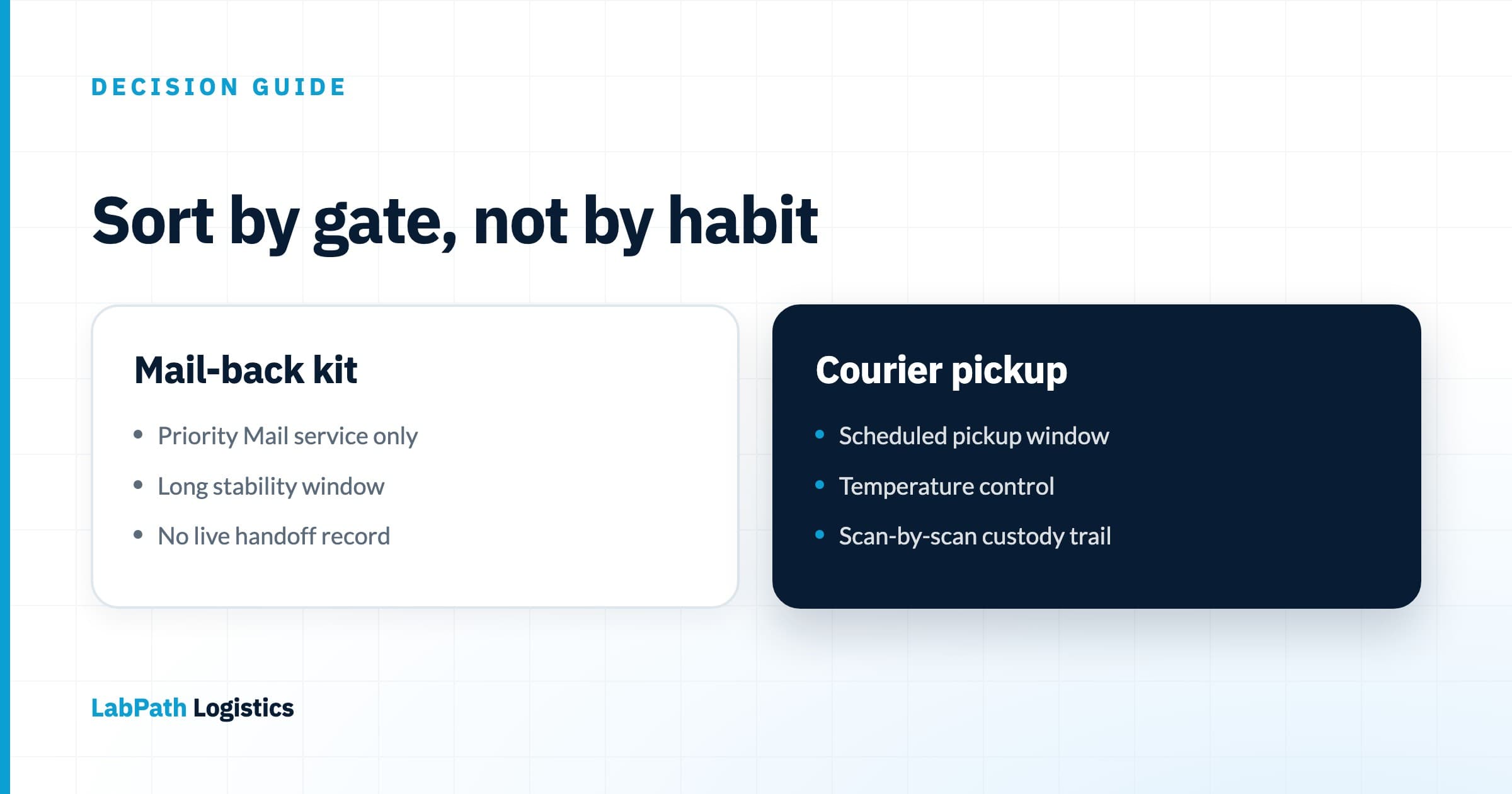
- Lab-provided route: often bundled with the lab account. It fits when the route's stop time lands after your last draw and before the cutoff. It does not fit when you need a second stop, a different lab, or STAT runs.
- Staff driver: low setup cost, but it pulls a staff member off the floor and raises vehicle, packaging, and liability questions. See our staff driver vs. courier break-even.
- Independent medical courier: fits when your draw hours and the lab route do not line up, when you send to more than one lab, or when you want pickup and handoff timestamps on every package. Start with a short pilot and the questions for a new courier.
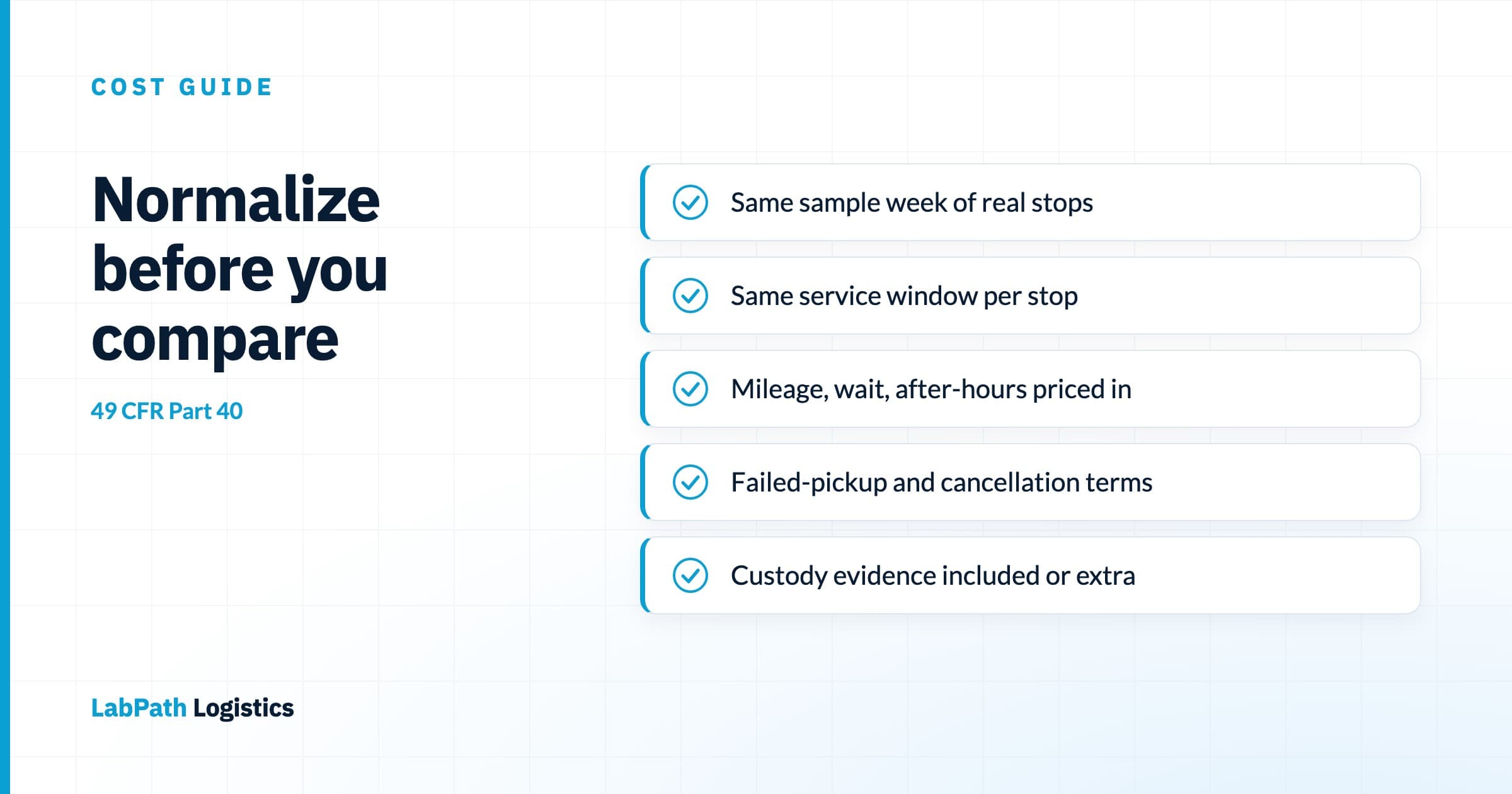
Budget for it now, not in month two. Our medical courier cost guide covers what drives the price, and the service levels page shows the public rate card. To price your lane before opening, use the nonbinding estimator. Estimates are not booking quotes.
LabPath Logistics is in early access for Greater Houston. Our booking-to-receiver-attestation workflow, including package QR scans, append-only custody events, and receiver signature, is verified locally; production dispatch, GPS, and temperature telemetry are not live yet. The booking model has no patient fields, by design. See our platform preview and privacy engineering notes for exactly what is verified.
Frequently Asked Questions
When should a new clinic set up lab courier service?
Before opening day, ideally two to four weeks ahead. You need time to confirm the receiving lab's same-day cutoff, set a pickup time against it, stock Category B packaging, and test one dry run. Setting it up after the first patient draw means specimens wait while you decide.
Does the lab provide courier pickup for a new clinic?
Many reference labs run routes for client offices, often tied to the lab account. Ask the lab for the actual stop time at your address and whether it can add a second stop. If the stop time lands before your draws or after the cutoff, you will need another option.
What packaging does a clinic need to send specimens to a lab?
Diagnostic specimens shipped as UN3373 Category B generally use triple packaging under 49 CFR 173.199: a leakproof primary container, a leakproof secondary container, absorbent material, and a rigid outer package. Your lab or courier may supply the materials.
Does a medical courier need patient information to pick up specimens?
No. A courier needs a pickup address, a destination, a pickup time, and a handling class such as refrigerated or room temperature. Requisitions and patient identifiers stay with the clinic and the receiving lab.